Monday, April 16, 2012

N is for Networks

[This is the 14th of my April A-Z Challenge series of posts on Symbols, Glyphs, and Sigils. Each day I'll try to include some material that old-school role-playing gamers will find useful, but I can't guarantee that there won't also just be a few posts filled with weirdness for the sake of weirdness....]

I hope today's topic isn't too much of a cheat, since I don't have a simple "symbol" for the idea that I'd like to talk about.  (Try these, if you really crave one?)  I also hope this idea isn't too much of a re-tread of stuff I talked about on E-day and I-day... There are many cool aspects to interconnected and interdependent Networks, no matter what the "nodes" and "links" actually represent.

Today I'm thinking about political and diplomatic networks.  I guess the "nodes" could be towns, cities, nation-states, or planets (the latter in a sci-fi setting!).  The links between them are relationships:  Alliance or enmity?  Do trade goods flow freely?  Does a common religion forge a bond?  Prior to the modern age, the INTENSITY of feeling between two regions (whether friend or enemy) was probably tightly correlated with the distance between them.  These days, that's probably still largely true, but technology is making distance less of an issue.  Here's a graphical representation of a randomly distributed set of nodes, where the thickness and brightness of the linking lines depends only on physical closeness:


One of the fun parts about tabletop role-playing is setting up a "sandbox" type world for the players to explore.  Game masters love making maps, but the real verisimilitude comes when working out the relationships that link the points on the map together.  Alexis Smolensk is infamous for delving deeply into the economic aspects of these linkages.  Old-school RPGs often had "racial preference" tables that told you what the various demi-human species thought of one another.  1st edition AD&D used the following continuum of default feelings:

preference > goodwill > tolerance > neutrality > antipathy > hatred

...and I think it would be straightforward to apply these labels to neighboring towns and cities, as well.  In a similar vein, I've seen some computer variants of games like Diplomacy and Civilization use specific hierarchies of political relationship (see here or here, for example) as a way to quantify the difficulty or ease of accomplishing specific goals.  I've assembled a few of these lists together to form the following gradation of 11 steps...


One could imagine any connection between two locations on the map having a known "temperature."  Over time, it can heat up or cool down -- and it's especially fun when the player characters become embroiled in these events.  In a fantasy, feaux-feudal setting, maybe something like Jeff Rients' random castle shenanigans could kick off a chain of events that cause the mercury to skyrocket!  :-)

Saturday, April 14, 2012

M is for Moon Letters

[This is the 13th of my April A-Z Challenge series of posts on Symbols, Glyphs, and Sigils. Each day I'll try to include some material that old-school role-playing gamers will find useful, but I can't guarantee that there won't also just be a few posts filled with weirdness for the sake of weirdness....]

It's full-on geekiness here at the blog today for some J. R. R. Tolkien action... In The Hobbit, our heroes learn that their treasure map has some hidden writing on it -- writing that only becomes visible when held up so the Moon's light shines through it.  (And it's got to be the same Moon-phase and season as when the words were first written with a magic silver pen...)


So today's symbolism isn't so much the runes of Tolkien's invented languages, but the idea of the rays of a celestial body "activating" a bit of time-sensitive magic down here on Earth.  This of course can cross over into various interpretations of astrology.  Also, the Theosophists often get all rainbowy with their seven rays shining down on us and correlating with the classical planets.

A few days ago, I talked about the British Hermetic Order of the Golden Dawn and its eclectic Victorian wizardry.  They taught their advanced initiates some very literal "ray theory" when showing them how to do magical alchemy.  Their "Z-2" document contained a step-by-step procedure for creating the philosopher's stone (correlated with the steps of their Neophyte initiation ritual... i.e., the alchemist is "initiating" the dead matter and enlightening it to a higher level!)  The process involved exposing the ingredients to the rays of the Sun and Moon at precise times. Some practical alchemists have picked nits with the details given in the Z-2 paper, but French Golden Dawn scholar Jean-Pascal Ruggiu says not to dismiss them so quickly:
Another discrepancy of the Z.2 document with other secret operative alchemical works concerns the exposure of the matter to sunlight and moonlight, the sequences which are not correct. However, the mere fact that this process is given proves that the author of the Z.2 document was really well instructed in the mysteries of Alchemy, because this indication was never revealed in published texts (although it was often shown in many plates). Indeed, the action of light upon the matter, and above all, how and when it has to be applied, is one of the main secrets that the Philosophers reveal only to their pupils after due initiation and under oath. Fulcanelli gave a very good definition of Alchemy as being "the art of transmutation of the matter by the power of light."
Who's energizing who here?
Kind of also makes me think of various flavors of light therapy and color therapy!  After all, if the Golden Dawn could take their initiation rituals and apply them to "inert" matter, then why not turn the tables and apply some other (meta)-physical techniques back onto the initiates themselves?  :-)

Inventive RPG game masters will find dozens of ways to use these ideas to spice up their magic items and spells. If you're still scratching your head about how it can be fit into a rollicking picaresque series of adventures, see how Aang and friends dealt with various astronomical alignments, focused sun-rays, and doom-bringing celestial objects!  :-)

Friday, April 13, 2012

L is for the Lion's Paw

[This is the 12th of my April A-Z Challenge series of posts on Symbols, Glyphs, and Sigils. Each day I'll try to include some material that old-school role-playing gamers will find useful, but I can't guarantee that there won't also just be a few posts filled with weirdness for the sake of weirdness....]

Today is another secret hand signal (like old Ficus)... this time a handshake of recognition amongst the Freemasons.  I don't think I'm giving away anything TOO über-secret, here, since the source of my image below is almost 150 years old, and it is often derided by Masons who talk about its many errors.

Specifically, many modern-day Masons say that the Spock-like separation of fingers is no longer done that way...

Suffice to say, the "Lion's Paw" is taught to the new Mason at a climactic point in their final initiation ceremony, and it involves death, resurrection, and bonds of brotherhood that are meant to extend beyond the grave.  In some versions, it also involves some grisly imagery of flesh tearing away from the bone.  When introducing it, they often mention the biblical Lion of the Tribe of Judah, which is often identified with Jesus by Christians.

It reminds me of one of the most memorable scenes from the third of C. S. Lewis' Narnia books.  Poor annoying Eustace -- the Steve Urkel of this book -- was turned into a dragon because of his bad behavior.  But God-Lion Aslan knew that the only way to fix him was to remove that pesky dragon skin...
But just as I was going to put my feet into the water I looked down and saw that they were all hard and rough and wrinkled and scaly just as they had been before. Oh, that's all right said I, it only means I had another smaller suit on underneath the first one, and I'll have to get out of it too. So I scratched and tore again and this underskin peeled off beautifully and out I stepped and left it lying beside the other one and went down to the well for my bathe.

Well, exactly the same thing happened again. And I thought to myself, oh dear, how ever many skins have I got to take off? For I was longing to bathe my leg. So I scratched away for the third time and got off a third skin, just like the two others, and stepped out of it. But as soon as I looked at myself in the water I knew it had been no good.

Then the lion said - but I don't know if it spoke - "You will have to let me undress you." I was afraid of his claws, I can tell you, but I was pretty nearly desperate now. So I just lay flat down on my back and let him do it.

The very first tear he made was so deep that I thought it had gone right into my heart. And when he began pulling the skin off, it hurt worse than anything I've ever felt. The only thing that made me able to bear it was just the pleasure of feeling the stuff peel off.
That did the trick for Eustace's inner character, too... but yikes!

This whole "secret handshake" thing also got me thinking about secret societies in RPGs. They're usually encountered for highly skilled members of certain elite classes (assassins, monks, thieves, etc), but what about the Average Joe?  Suppose that there is a secret order of plain, zero-level folks... but with JUST a bit of magic contained in that arcane handshake. The performance of the handshake allows one order-member to temporarily transfer one or more of his hit points to his fellow.  When you've got only 1d4 hp, a brotha can really help out a brotha with just a very minor gesture like this!  The recipient's gain will dissipate in 24 hours, but the giver's loss will need to be healed as if any other type of damage had been done.  If someone gets help from multiple people and gets a full HD of hit points, that's also equivalent to a "life energy level" when encountering level-draining undead.

Thursday, April 12, 2012

K is for Khabs Am Pekht

[This is the 11th of my April A-Z Challenge series of posts on Symbols, Glyphs, and Sigils. Each day I'll try to include some material that old-school role-playing gamers will find useful, but I can't guarantee that there won't also just be a few posts filled with weirdness for the sake of weirdness....]

Have I talked much about the Hermetic Order of the Golden Dawn on this blog before?  I've probably mentioned it, but I'm sure I haven't successfully conveyed its sheer awesomeness. It was a real-life British occult society that trained some major cultural figures of the early 20th century, and inspired many modern day artists and magi (like Alan Moore) with its tradition of magic and eclecticism.  It also produced some pretty psychedelic imagery, such as this shot of a modern reconstruction of its sooper-secret Inner Order Vault of the Adepti:


For today's symbol, there are literally hundreds to choose from, just in the above image alone!  But instead I'd like to talk about a coded set of passwords from the GD's very first initiation ritual.  A new candidate who wants to become a GD Neophyte is put through an elaborate ritual that symbolically shows how the Order will take them from Darkness to Light.  The initiate wears a "hoodwink" over his or her head through most of the ritual, but at its climax the hoodwink is removed and the initiate sees the Egyptian-themed temple for the first time, and sees the garishly robed three main officers in a triangle surrounding him or her.  At that key moment, they say "We receive thee into the Order of the Golden Dawn," and they take turns intoning mystic words:

The Hierophant says:  KHABS
The Hiereus says: AM
The Hegemon says: PEKHT
The Hiereus says: KONX
The Hegemon says: OM
The Hierophant says: PAX
The Hegemon says: LIGHT
The Hierophant says: IN
The Hiereus says: EXTENSION

The Egyptian phrase "Khabs Am Pekht" is said to mean the same thing as the Greek phrase "Konx om Pax," and they're both supposed to mean "Light in Extension."  (The Greek phrase is from the Eleusinian Mysteries, and I don't think the historians have yet figured out what it really means...)

"Where are the symbols?" you may ask.  Well, later, when the initiate advances a few more grades, he or she is given documents that explain the esoteric significance of the Neophyte admission formula, and that document gives the Egyptian hieroglyphs and Coptic transliteration of the "Khabs Am Pekht" part:


(I'm actually not 100% sure that I'm allowed to present the scan of these hieroglyphs above.  For some reason, all published versions of this document don't show it.  The above comes from a scan of a hand-copied version from the 1890s that was sent to me by a private Golden Dawn scholar.  Hopefully showing just a tiny snippet of that scan isn't verboten...)

To me, what's most interesting about it is that it's just... not... quite... right.  Many of the correspondences between Egyptian and Coptic are straight outta Champollion, but others, like the star and cross for "a" and that recumbent dude at the end, just don't mean what they think they mean.  We're left wondering what kind of convoluted game of "Telephone" this drawing went through to get to where it is...

In fact, the belief that "Khabs" meant some kind of bright, shining light eventually led Aleister Crowley to make the word a key concept in his religion of Thelema.  Some argue that this distortion of ancient Egyptian concepts somehow invalidates the modern-day usefulness of Thelema as a philosophy or world-view, but I think that it's hardly any different from the millennia of borrowing and syncretism that preceded it in every other religion...

Anyway, there are many possible ways to relate the above whirlwind of ideas to role-playing games.  Back in the 1990s, there was a pretty cool Call of Cthulhu Supplement about the Golden Dawn that gives 1890s-era CoC Investigators whole new worlds of occult creepiness to explore.  Even without that, GMs could make use of the infamous ciphers that were used to encode the first version of the GD's ceremonies.  From some of the images shown in the above cipher link, I think Trithemius would have loved the AD&D Combat Computer!

Wednesday, April 11, 2012

J is for the Jolly Roger

[This is the 10th of my April A-Z Challenge series of posts on Symbols, Glyphs, and Sigils. Each day I'll try to include some material that old-school role-playing gamers will find useful, but I can't guarantee that there won't also just be a few posts filled with weirdness for the sake of weirdness....]

Well, I can't wait until September 19 -- or even for the letter "Arrrrr" later this month -- so today will just have to be about pirates.

Blackbeard's favorite version
In the 1600s and 1700s, most pirates just flew a pure black flag, but others added the skull and crossbones or other scary signs of death and dismemberment (including more subtle memento mori such as an hourglass) to frighten their victims into surrendering without a fight.  Nobody knows for sure where the name "Jolly Roger" comes from, but many believe it's a derivative of the French joli rouge (pretty red), for the blood-red versions of the flag that were sometimes flown.

Pirates are often stock non-player characters in many kinds of fantasy adventure games. However, often people just look to the classics (from Treasure Island to Jack Sparrow) and make their pirates pretty stereotypical.  Fun as that can be, here's a random table to throw a monkey-wrench into those bog-standard pirate tropes...

Our Pirates Are Different:  Roll d20 for Freebooter-Themed Foibles
  1. The captain has a strange psychological quirk.  There are plenty of quirk/flaw lists out there... try Mike Monaco's modification of Galloway's classic Bogey Table.
  2. The captain has a strange magical anomaly.  Roll 1d20 on Dyson Logos' table of unusual characteristics for pirates from last year's April A-Z.
  3. The captain is powerless.  He or she is secretly the puppet of another (random) crewmember.  Is it magical coercion?  Or just good old blackmail?
  4. The captain is a stereotypical Long John Silver type, but the crew is all made up of people from a very different part of the world.  How did these folks get together?
  5. The captain is a woman.  No... scratch that.  The "pirate queen" trope is getting pretty stereotypical, too.  How about a pirate Red Queen?
  6. The crew are all lycanthropes.  When is that next full moon?
  7. The captain and crew are all devotees of a strange deity unknown to the PCs.  Will they try to convert the PCs?  Or sacrifice them?
  8. A seemingly innocent cabin boy is planning mutiny.  He has almost half of the crew on his side.  (The captain killed his parents...)
  9. The crew has a good luck charm that they believe keeps them safe in battle.  It's displayed out in plain sight, but it's taboo to talk about it too much or touch it disrespectfully.  Hopefully it's nice and shiny, so one of the PCs won't think anything of picking it up, tossing it around, and saying "Hey, what's this?"
  10. Down below, the crew keep a powerful druid prisoner and force him (with a stolen Ring of Human Influence) to constantly cast Control Weather to give the ship good seas.
  11. The captain and crew are wanted... not by the authorities, but by all other active pirates in the area for breaking an article of the Pirate Code.  Preferably one that is fairly incomprehensible to the PCs!
  12. The crew is divided into several (four? five?) warring factions.  Everyone is out to get everyone else, but they're so cagey and shrewd no direct hostilities are ever carried out.
  13. The pirate ship is a strange color, and/or has sails with strange things painted on them.  Who's the on-board artiste?
  14. At night, nobody goes below.  At the last port of call a random monster scurried aboard, and the ship cast off without knowing.  It's killed several crew members already, and it makes sounds that chill you to the bone, me hearties... but it never comes up into the open air...
  15. The ship was captured from the local navy and still looks very much like a ship of the line.  ("So, is this the new Bluesmobile or what?")
  16. The ship still drags about a dozen corpses from a recent keelhauling.
  17. The ship is haunted.  Not a semi-ghostly curse like the Flying Dutchman, but it's literally haunted by the spirits of people killed by the captain and/or crew.  Will these ghosts eventually become numerous (powerful) enough to sabotage the ship, or attack crewmembers directly?
  18. Once per day, the ship can magically go underwater for 30 minutes of super-cool submarine attack action...
  19. The ship is equipped with the equivalent of stinkpot projectiles (adjust tech level to be era-appropriate).  And they literally stink, too.  Well, how else do you expect them to efficiently get rid of the contents of their... poop deck?  :-)
  20. Roll another d20 for more randomness "At Sea in the Tropics."  See pages 61-62 of the 2011 Secret Santicore, and combine the sub-tables titled SHIPS and CREEPY.
Once your quirks are known, use this to name the ship, use this to name some of the pirates, and you're ready to cast off!

Tuesday, April 10, 2012

I is for IDIC

[This is the 9th of my April A-Z Challenge series of posts on Symbols, Glyphs, and Sigils. Each day I'll try to include some material that old-school role-playing gamers will find useful, but I can't guarantee that there won't also just be a few posts filled with weirdness for the sake of weirdness....]

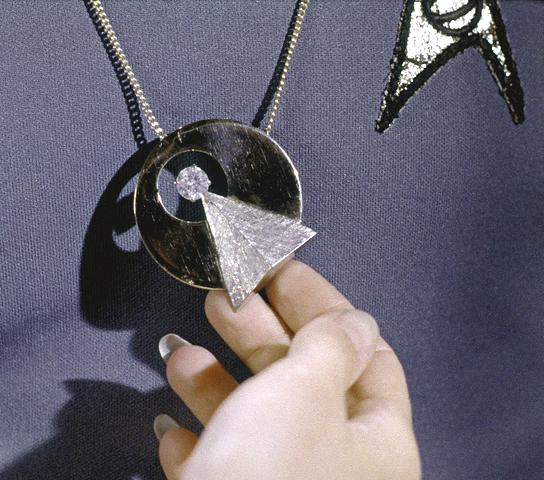
Known by the most unbridled denizens of geekdom such as myself, IDIC is an acronym from Star Trek that stands for "Infinite Diversity in Infinite Combinations."  It's a core principle of the logical philosophy of the Vulcans, and it also comes in nifty pendant form:


In reality, the IDIC pendants seem to have been a crass marketing ploy by Trek creator Gene Roddenberry... so crass that even Leonard Nimoy needed lots of convincing to wear it on the show.  But the idea of it really resonated for me back in the day, so I'll keep my fond memories of it anyway.  :-)

Many fans embraced "infinite diversity" because of its resonance with tolerance for alternate ways of living.  I always thought that trying to fold your mind around "infinite combinations" gets quite close to the sacramental core of the Glass Bead Game (see collected quotes here).  It's also reminiscent of the ideas in my letter E post of a few days ago.

One great way to stretch your mental muscles with IDIC is to think about the various degrees of infinity that mathematicians have come up with.  Georg Cantor got the ball rolling in the late 1800s with transfinite numbers, but that was only the start.  Want to take a ride?
  • First up is the idea of a "countable infinity."  You know:  1, 2, 3, 4, ...  The "dot dot dot" just means to keep on going forever.  Cantor proved that if you can write down an algorithm that accounts for all the members of a set by counting (even if it goes on forever), then that set has essentially the same number of members as any other set that satisfies this criterion.  This can be a bit counter-intuitive, since it means the set of all even (or odd) integers is the same size as the set of ALL integers.  The set of all rational numbers (integer divided by an integer) is also countable, and thus the same "size" as the set of all integers, too.  This degree of infinity is called Aleph-Zero.
  • Are there sets bigger than Aleph-Zero?  Yes!  The set of all real numbers (including all those pesky irrational numbers like pi and the square root of 2) contains an "uncountably" large number of members.  Unlike, say, the set of all integers, there is no way to say what the "next" real number is that follows any given real number. There are always infinitely more reals squeezed in between any two that you can write down.  This degree of infinity is called (by some) Aleph-One.
  • Are there sets bigger than Aleph-One?  You bet!  As big as it is, something even bigger is the set of all possible SUBSETS of Aleph-One.  In other words, the set of all possible "infinite combinations" of the members of Aleph-One.  There's Spock and his pendant again!  This degree of infinity is called Aleph-Two.
  • You can keep on going and going, with Aleph-(N+1) being the set of all possible combinations of the members of Aleph-N.  You can even substitute another "Aleph number" in for N.  But some mathematicians take the next leap to be the following: Consider an infinite set so big that it's the SAME size as the set of all of its possible subsets.  It's so expansive that it is its own subset.  Your mind has to really stretch to see how that could be possible.  Reading the mathematics literature starts to get hard to follow from here on, but I think these "Inaccessible Cardinal numbers" are often given the symbol theta.  (And there's the Ecology symbol again?)
  • The mathematicians go on, with hyper-inaccessible cardinals, indescribable cardinals, ineffable cardinals, and so on...  I can't keep them straight!
Anyway, I highly recommend Rudy Rucker's classic book Infinity and the Mind for those who want to dig deeper -- or climb higher up that infinitely tall mountain!

Monday, April 9, 2012

H is for the Helm of Awe

[This is the 8th of my April A-Z Challenge series of posts on Symbols, Glyphs, and Sigils. Each day I'll try to include some material that old-school role-playing gamers will find useful, but I can't guarantee that there won't also just be a few posts filled with weirdness for the sake of weirdness....]

The Helm of Awe, or Ægishjálmr, was a magical symbol worn by Norse and Icelandic warriors for protection in battle and to invoke fear in one's enemies. How precisely it was to be "worn" varies a bit with time and place -- sometimes it's drawn on the forehead, sometimes tattooed on the body, and sometimes it's meant to represent an actual helmet (as in Wagner's Tarnhelm). The web is full of modern-day drawings and tattoos, but I wanted to show (at right) a scan of a page from an actual Icelandic grimoire that highlights the original symbol.

There are a lot of interesting things about Icelandic symbol magic that I could talk about, but you can get a feel for a lot of it from the above links.  One thing that particularly jumped off the screen at me, when I first saw the Helm of Awe, is its eerie similarity to magical symbols drawn centuries later, half a world away... Have a look at a Haitian Voudon symbol (Veve) for the imposing Baron Samedi:

Like medieval European magic circles (and Tibetan sand mandalas?), these symbols are created by ritually strewing various powders on the ground in the appropriate patterns.  However, Baron Samedi's sphere of influence is kind of the flip side of what one would want from the Helm of Awe.  One invokes survival with the Helm... but the Baron is the one who accepts people into the realm of the dead.  Well, maybe this is just the mirror image of the same idea.  Soldiers going into battle often must meditate on the idea that "this may be a good day to die."

In RPGs, there have been some products that describe a kind of "Tattoo Magic."  See a Pathfinder source book, as well as a page of Rolemaster house rules.  Borderline creepy that they are, they still don't seem to approach the religious aspect of both the Helm and the Veve.  Perhaps it's the CLERICS that should get these kinds of powers when they choose to mark themselves with the symbols of their gods.  Of course, if it's just drawn on (and not permanently tattooed) then it wouldn't impart as strong a bonus.  And woe to the cleric for whom the drawn-on symbol accidentally rubs off!