Friday, August 16, 2013

Can 30 year old ad copy make you cry?

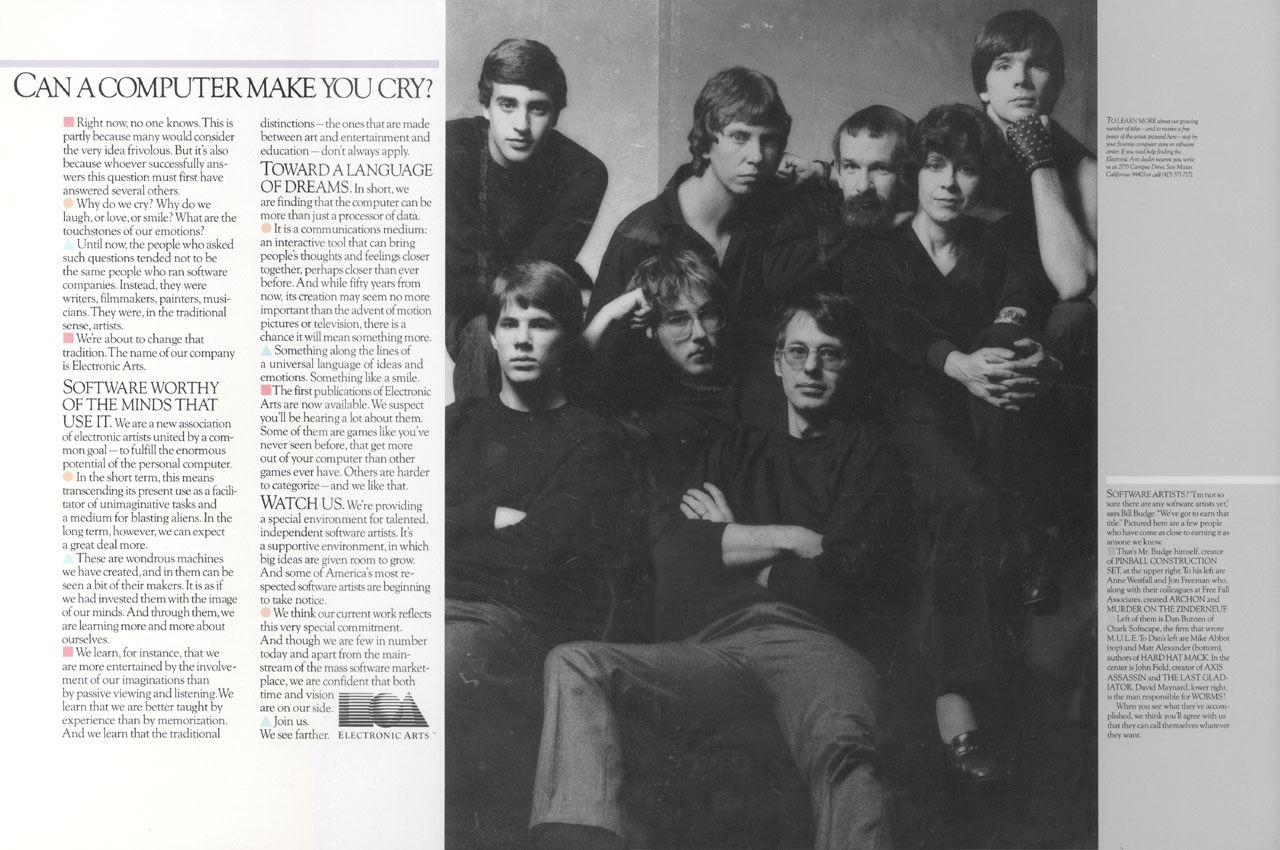
Although I haven't yet discovered any new Electronic Arts ads, like the one that I blogged about earlier, check out what I did find, in the September 1983 Scientific American...

Click for big ideas
Yup, the original.  Bagged in the wild, two months prior to the appearance of the Bill Budge follow-up ad that I posted earlier.  Its full text is archived HERE by Chris Hecker, who was kind enough to link to my previous post.

Is it a coincidence that my nostalgia for this heady era of "retro-computing" shares similar space in my brain with a love of fantasy role-playing games of the same era?  My own (still-unfinished) contribution in that arena is called Homebrew '82, after all.  What the two things share is a fierce Do-It-Yourself ethic that may still exist in some places, but has been largely supplanted by many more people that are happy with just buying stuff and using it OTS (off the shelf) or playing it RAW (rules as written).

Yes, yes, I know.  "In my day..."

But there are other, possibly more timeless, connections.  The EA manifesto above says that what they're after is "Something along the lines of a universal language of ideas and emotions."  But how is that any different from this...?
I suddenly realized that in the language, or at any rate in the spirit of the Glass Bead Game, everything actually was all-meaningful, that every symbol and combination of symbols led not hither and yon, not to single examples, experiments, and proofs, but into the center, the mystery and innermost heart of the world, into primal knowledge. Every transition from major to minor in a sonata, every transformation of a myth or a religious cult, every classical or artistic formulation was, I realized in that flashing moment, if seen with a truly meditative mind, nothing but a direct route into the interior of the cosmic mystery, where in the alternation between inhaling and exhaling, between heaven and earth, between Yin and Yang, holiness is forever being created.
That's Hermann Hesse, from The Glass Bead Game.

That's what I still think is possible to create, now, a mere 30 years after Bill Budge put on that silly leather glove and began to remake the world.  Computers may help make it easier to accomplish, but they're just tools.

Let's get building!  :-)

Monday, August 12, 2013

Unearthing another classic EA print ad

I spent a rare weekend away from all email and internet, and I'm back with a unique relic from an era that I've been thinking a lot about lately.  In my review of Austin Grossman's novel "You," I linked to an old print advertisement for Electronic Arts titled "Can a Computer Make You Cry?"  Grossman also talked about the impact this ad had on his characters, and it seems to have been rather pivotal in the computer game industry.

However, I had no idea there were other EA advertisements other than that one!  While paging through the November 1983 issue of Scientific American, I came upon this:

Click for bigger version

I searched for pieces of its text online, and could not find it anywhere.  Is it possible this intriguing follow-up ad is not archived anywhere on the net?  No worries, though, because the remainder of this post contains the full text, transcribed hopefully with no errors by yours truly.

First, disclaimers:

(1) I didn't want to put my old magazine through the hazards of a scanner, so the above cell-phone pic is as good as it gets for now.  I could attempt to snap higher resolution pics, but now that you know it's the Nov. '83 issue of SciAm, and that it's on pages 24B and 24C of said issue, you may be able to find it elsewhere.

(2) I presume the text below remains copyrighted by Electronic Arts, but I hope my transcription can be viewed as "fair use" since it is of clear historical interest, and it seems to exist nowhere else on the net (as of August 2013 anyway).

(3) There are some unintentionally chuckle-worthy moments in this text.  Maybe there's a bit too much of a halo erected around Budge, too.  Still, it's a fascinating slice of life from those heady early days.  Please comment away about the content.

(4) There may be other ads in this series, too.  If I find any more, as I go through my moldy stack of magazines, I could post them.  Is there interest in that?

- - - - - - -

[Header text:]

Bill Budge wants to write a program so human that turning it off would be an act of murder.

Are you sure you want to call this guy an artist?

[Main body text:]

In a bedroom in a frame house in Berkeley, California, a guy who looks like he might have stepped out of a TV family series is playing with some ideas that could change your life. They are ideas that are amusing, even charming. And they are ideas that are, quite frankly, a little scary.

His name is Bill Budge and he talks about things like how programming for a microcomputer is like writing a poem using a 600-word vocabulary. He talks about how the elements are so limited and how you have to make them mean so much. And he talks about how, if you do it right, you can make those elements suggest something more than aliens -- something that begins to make you believe it has a life of its own, something he calls "a software friend."

A software friend. It sinks in slowly.

To create a personality in the computer, you have to come to some decisions about what the personality is in the first place. We often think of it in nearly the same way we think of "habit" or "character traits" -- a way of describing continuity in our behavior from one moment to the next.  (F. Scott Fitzgerald called it "a series of consistent gestures.")

According to Budge, however, the essence of a software friend is quite the opposite. "Creating the illusion of personality," he says, "means creating an intelligence that's always changing. It reacts differently to different situations."

The idea is probably ten years away from actuality. But when it comes to working such a mojo on our home computers, well, Budge stands about as good a chance as anyone of pulling it off.

After all, look at PINBALL CONSTRUCTION SET. Everyone always knew Budge was good, but when he cranked out PINBALL, well, the switchboard lit up like a Christmas tree.

It was a program that changed the way people thought about personal computers. Instead of reacting to the machine, you were suddenly inside it, trafficking information this way and that, making things. It was like programming, but with familiar items -- you'd grab this bumper, move those flippers, change the colors, then shoot a ball through it all and wonder. Maybe for the first time in a popular program, you could feel the power of the computer.

Steve Wozniak called it "the best program ever written for an 8-bit machine." And suddenly, what-Budge-would-do-next was something you heard people talking about. To Budge himself, however, things weren't quite that simple.

"Sometimes I worry," he says. "I worry about the ability of software to absorb you, focus on you, steal you away from your family and friends. Because in its short-term excitement, it seems to be more interesting. Of course, it's not."

He leans on his hand. "Not yet."

[Upper-right inset text:]

Bill Budge's classic PINBALL CONSTRUCTION SET is just one of more than a dozen remarkable publications by a company called Electronic Arts. We're an association of software artists, united by a common goal: we want to realize the potential of the home computer. To do this, we're creating software worthy not only of the capabilities of these machines, but also of the minds that use them. If you'd like to know more about our company and its products, call ... or write us at ... [old contact info omitted]

- - - - - - -

Friday, August 2, 2013

A trip to Old Number Six

I spent a rare day off today making a pilgrimage to a favorite used bookstore...


With more than 100,000 musty treasures available for browsing, how can you go wrong?  I picked up a book of poetry to better acquaint myself with one of my April A-Z post subjects, and I also found a long-sought occult tome for under $10 that I've only seen for over $50 on the webernets.

I also happened to see a rare (?) role-playing game book that was recently on a list posted by Catacomb Librarian, here, as one of several that deserve more attention in the blogging world.  (Don't worry about it being lost to history, though... the good Librarian has already started to dig into its quirky details, here.)  Unfortunately, the proprietors must have known its worth, too... $45 was too steep for me, for something I'd most likely never play.

Anyway, it was a fine day.

Also, a few other random bits that don't quite deserve their own posts...

(1) As a follow-up to my previous review, I eventually realized that Austin Grossman's characters Simon and Darren were probably not based on Jay and Silent Bob (duh), but more likely on two, you know, actual pioneers of the home computer age...


I'm pedantic and geeky, but I never claimed to be quick on the uptake!  :-)

I'd have used pictures of the real guys, but these actors give off vibes that are much more reminiscent of my conception of Simon and Darren.  (In Grossman's book, for example, Darren was a lot slicker and smarmier, and Simon was a lot more psychologically damaged, than the real Jobs and Woz probably were back in the day!)  This movie comes out in a few weeks... if any of you see it, I'd be curious to hear your opinions in the comments.

(2) A couple of days ago, I spent far more time than I'd care to admit scrolling through a web page called Awesome People Hanging Out Together.  Come on, they found this picture:


That's Count Dooku on the left, Grand Moff Tarkin on the right, and in the middle... the Candyman!  cha ch'kan... cha cha ch'kan...   Not a Star Wars or Rat Pack fan?  Okay, how about:


Look closely... "Daydream believer, and a homecoming..."  "You want the truth? You can't handle the truth!"

(3) Blah blah blah third thing.  I just realized that this one probably could and should be expanded to a full post.  I'll hold off on it for now, in order to learn a bit more about this topic before proceeding.

Friday, July 26, 2013

Cephalopod Coffeehouse: Grossman's You

I'm pleased to be a part of the Armchair Squid's go-your-own-way online book club again.  This past month, I read Austin Grossman's recent novel titled "You."  It's a slightly nostalgic look at the growth of the video game industry through the eyes of a fictitious team of programmers who were in it from the early days of home computers.

I ended up not being totally pleased with the book, but there were some good things.  Let me first issue praise where praise is due...
  • I loved the sense of camaraderie and purpose of the core characters, who built up a thriving video game empire from humble beginnings as outcast high school students.  Their early years -- especially their time at an experimental computer camp in the woods of western Massachusetts -- reminded me of the early years of the tight-knit team of "losers" from Stephen King's novel "It."  (And no, I didn't think of that just because it's another novel with a pronoun for a title!)
  • As someone of pretty much the exact age of the protagonists, I recall those early years, too, and I think Grossman captured a lot of its charm quite nicely.  I certainly shared the characters' drive toward their Platonic ideal of the Ultimate Game.  Some blurb on the back cover said something to the effect of "Now I want to go break out my old Commodore 64 and revisit some of those games."  I felt the same way.
But I couldn't ignore the problems.  Much of the book was built on flashbacks, and they were rolled out kind of haphazardly.  Almost as if Grossman was just making it up on the fly, as each new chapter was written.  In the early chapters, the present-day versions of the characters should have known about their past experiences together, but it's almost like they had amnesia until the flashbacks were presented.

The protagonist, Russell, was kind of a bland cipher, and (to me) borderline unlikable as a person.  Instead, I wanted to know more about Simon, the brilliant, unstable innovator who died a few years before the "present day" action of the book -- but who nonetheless drove much of the plot.  I think I've known a few people like Simon in my life, and I was left wondering if Grossman ever really knew or understood someone like this.

Part of me wants to wax philosophic about how modern literature seems uncomfortable with straightforwardly heroic personalities.  Do they see it as more preferable to have a wavering dud like Russell as the point-of-view character, than someone like Simon?  Someone who seemed to be honest, good, and unflinching in his will, even with flaws, even unto his own demise?

I was also unhappy with how the plot got resolved, but I'll leave out spoilers.

Still, the story made me think about a lot of things that I hadn't thought about in a long time, and it made me think about them in new ways.  I'm glad I read it, even if I wanted to throw it across the room when I was done.  :-)

- - -

Oh, one other thing.  Grossman's descriptions of Simon and his best pal Darren (the latter being the taller, smooth-talking pitch man who helped convey shy Simon's visions to the wider world) reminded me of another pair, where one of them does the talking for both... often to excess...


This comparison also got me to thinking of a few similar pairs in popular culture, where there's one who is silent and supposedly "deep," and the other who compensates by being more of an over-the-top goofball...


Can you think of any others?

Saturday, July 20, 2013

Music of the Spheres

In my last post, I talked a bit about a metaphor I found on the Internet that compares musical tonality to a kind of "gravity" exerted by heavenly bodies.  That spurred on even more thinking about the ancient idea of the music of the spheres.  Going back to Plato and Pythagoras, the idea is that the motions of the planets, in their nested crystalline orbs, create a celestial music that we humans cannot hear. There's also some astrology in there, since the heavenly harmonies may at times be in resonance with certain earthly harmonies.  Fans of Shakespeare's Merchant of Venice will also recognize these ideas seeping into the Elizabethan Renaissance...
"Here will we sit and let the sounds of music
Creep in our ears. Soft stillness and the night
Become the touches of sweet harmony.
Sit, Jessica. Look how the floor of heaven
Is thick inlaid with patens of bright gold.
There's not the smallest orb which thou behold'st
But in his motion like an angel sings,
Still choiring to the young-eyed cherubins.
Such harmony is in immortal souls,
But whilst this muddy vesture of decay
Doth grossly close it in, we cannot hear it."
I was thinking a bit more concretely about this, and I looked again at the numerical ratios that define notes and intervals.  Even in my muddy vesture of decay, I thought it would be fun to extend that particular idea to the planets.

In the last post I mentioned the difference between equal-tempered notes and those that you get from just intonation.  Equal temperament is just taking the octave (the distance between any given note and a note with twice as high a frequency) and splitting it up equally into 12 semitones.  Music nerds break up the octave into 1200 "cents," where each 100 cents is one equal-tempered semitone.  These are shown in the image below by the equal-sized blocks of color:


However, the notes that really sound the most harmonious don't fit exactly onto those 100-cent intervalsInstead, they're defined by simple ratios of frequency.  The perfect fifth, for example, is an exact multiple of 3/2 times the frequency of the base note, or tonic.  If you compute the cents of that interval, you get 701.9549560547 or so.  That's pretty close to 700.  Many other harmonious ratios end up being close to even hundreds in cents, and that's what made equal temperament so popular and useful.  The little white lines in the image above show where many of them fall on this scale.  I gave only one example -- see 590 and 610 -- where music theory folks prefer to distinguish between two notes, but an equal-tempered instrument like the piano can only play one "average" note that has to serve for both (600).  You know the old joke... you can tuna piano, but you can't tune a diminished fifth!

Music blogger Gary Garrett has talked about some other bluesy notes that fall even further away from the equal-tempered boundaries...


It was an eye-opener for me to see all of these -- and to learn where in popular music they're used, too.  There are so many possibilities!

But back to the music of the spheres.  I realized that each planet has its own "frequency" (i.e., the rate at which it orbits the Sun), and one could make similar ratios.  I gave it a try, using the Earth's frequency as the "tonic" with which all of the others are compared.  Earth is the natural "home key," of course.  (I guess I could go all Shakespeare again with "Man is the measure of all things.")  :-)  I chose to ignore octaves, since in music it's seen as insignificant, harmonically, to go up or down an octave.  I also picked some interesting asteroids and one famous comet, since they're just as much fellow travelers around the Sun as the big planets.  Here's where their frequency ratios fall, musically...
Notice the big clump of planets right near the Earth at the top.  Far-away Pluto orbits the Sun once every 248 years, but that's close to 256, which would be exactly 8 octaves up from the Earth's orbit once every 1 year.  Mercury orbits once every 0.24 of a year, which is close to a quarter (2 octaves down).  All those near halves, doubles, halves of halves, doubles of doubles, and so on, fall very close to either the unison or the octave.  These were also noticed hundreds of years ago and codified into something called the Titius-Bode Law.  Modern astronomers don't quite know what to do with that "law," since it's not exact, and there seems to be no physical reason for the planets to be sitting at near factors-of-two separation like that.  "Coincidence" may be the best explanation, since the thousands of other extrasolar planets don't seem to follow such a law.

Notice also that Jupiter falls close to a perfect fourth, which is the inverse of a perfect fifth.  When I first computed these things, I used periods instead of frequencies, and Jupiter fell just about smack dab onto the perfect fifth.  (There's a reason for that, since periods are "inverses" to frequencies in just the same way as the musical inverses that I mentioned above.)  I almost posted the period-version of the chart, but the pedant in me knew that it's more honest an analogy to use frequencies like in music.  Anyway, in my last post, I quoted Gary Garrett comparing Jupiter's weak gravitational pull to a chord with a root on the perfect fifth!  More coincidence?

Who knows.  But I do know that these kinds of harmonious comparisons are just the ticket for thinking about the Glass Bead Game.  Hesse knew music was the key, as did Shakespeare...
"The man that hath no music in himself,
Nor is not moved with concord of sweet sounds,
Is fit for treasons, stratagems, and spoils;
The motions of his spirit are dull as night
And his affections dark as Erebus.
Let no such man be trusted. Mark the music."

Friday, July 12, 2013

Musical Gravity

I'm always on the lookout for interesting Glass Bead Game-ish analogies that link together far-flung ideas.  On the blog of musician Gary Garrett, I just found a doozy!  I've attempted to boil it down to a couple of eye-catching images, which I'll do my best to explain below.

First is the basic 12-semitone "chromatic" scale common to most Western music:

Melodic order
These 12 notes are also 12 intervals between notes, and I talked more in this old post about how human brains may be hard-wired into interpreting various intervals as happy, sad, angry, and so on.  Above, I assigned each note/interval to a color, and one can see how "close" any two of them are to one another by seeing how similar their colors are.

However, it turns out closeness isn't such a simple concept in music.  Melodies (the "foreground" tune) and harmonies (the "background" layers) work with different definitions, as Gary Garrett explained here:
Melodies “like” to move up and down on a linear scale. They want to go to a nearby note when they move — that is, near by in pitch. We hear, and sing, small movements in pitch better than we hear leaps.
Harmonies “like” to go to nearby notes too, but harmonic space is different than linear, melodic space. The 1 and the 5 are harmonic neighbors. In fact, they are as close together as notes can be, harmonically, without being the same note .... But they are far apart melodically — the 5 is almost at the midpoint of the scale.
There's been a long history of people trying to visualize "harmonic closeness" using graphical techniques.  Garrett summarized this history, and explained his own graphical "Lattice" technique, in this post.  Below is my own attempt to visualize his Lattice:

Harmonic order!


Note that the "color neighbors" here are spread out much more than in the melodic scale I showed above.  There's a method to this seeming madness:  the up/down axis follows the well-known circle of fifths, the upper-left/lower-right axis steps down in major thirds, and the lower-left/upper-right axis steps up in minor thirds.  These steps correspond to the natural harmonies that one would see, for example, by taking a stringed instrument and changing the length of the string by "simple" fractions like 3/2, 4/3, and so on.  Also, most chords (major and minor) can be formed by taking little triangular "clusters" of any three notes in this lattice.

I should make clear that my version of the lattice is much simpler than Garrett's in one notable way.  Mine uses the standard Western approximation of equal temperament.  It just shows the notes you can reach with the white and black keys of a piano.  Garrett is a fan of just intonation (which also intrigues me, as a wannabe Pythagorean), so there's much less repetition in his version of the Lattice than in mine.  In my version, say, C sharp is the same note as D flat.  In Garrett's, it's not!  :-)

But, you may ask, where's that Glass Bead Game-ish link between far-away ideas?  It comes in Garrett's recent post about "tonal gravity:"
I believe that the great driving force in tonal music, that creates the drama and story of the music itself (independently of any lyrics), is the longing for home. Home is the tonic. If a song is in the key of A, all the A’s in their various octaves will sound like home. 
...
It’s as though the tonic creates a sort of gravitational field around itself. It acts a lot like real gravity. The chords and notes move in this gravitational field, like planets and moons around a sun. The gravitational field follows a few basic rules:
  1. Movement away from the center creates tension; movement toward the center gives a sense of resolution.
  2. The closer you are to the center in your journey, the stronger the sensations of tension and resolution are. The field is stronger closer in, just like real gravity.
  3. The closer together two notes are, the more consonant, or harmonious, they will be when sounded together. The farther apart they are, the more dissonant they will be, the more they will clash.
Roots generate local gravitational fields. I think of them as Jupiter to the tonic’s Sun. When the root is on the 5, for example, it shifts the gravity field to the east on the lattice, and the 2 and 7 become harmonious, consonant notes, rather than dissonant ones. The tonic still has great influence, so the entire chord feels unresolved — a 5 chord pulls very strongly toward the 1 chord, a property that is heavily relied upon in Western music.
(Note: his phrase "east on the lattice," in my version, is "up.")

I love this analogy.  It falls right into place with my other thoughts about how tension and release must be core elements of the Glass Bead Game, since they're so universal across many different domains.  Now, what will I actually do with these beautiful ideas?  That, I'm not so sure about...  :-)

Thursday, July 4, 2013

Happy Independence Day!

 
"What light is to the eyes, what air is to the lungs, what love is to the heart, liberty is to the soul of man."
(any friend of Walt's is a friend o' mine!)