Showing posts with label unbridled geekdom. Show all posts

Tuesday, February 4, 2025

A Travel Guide to Neverness, version 2.0

A very long time ago, in a blogosphere far, far away, I gushed about my appreciation of the Neverness stories of sci-fi author David Zindell.  Then, about 13 years ago, I posted a PDF of what I called a Neverness FAQ (Frequently Asked Questions) document.

Now, since Zindell recently came out with a new novel set in this universe, I thought it was time to update that very old PDF.  I'm happy to announce version 2.0, linked here...


If links get broken, please also try:  https://tinyurl.com/nev-faq-2025

As before, this FAQ is spoiler-free for the plot, and it's split into four main parts:

  1. The Geography of Neverness (with a new & improved map)
  2. The Calendar of Neverness
  3. The Professions of the Order
  4. Glossary of Miscellaneous Neologisms

It's awesome that Zindell included his own glossary, timeline, and some other juicy behind-the-scenes material at the end of The Remembrancer's Tale, but I still think there's some unique value in my fanboy-ish production.  :-)

I'm also excited to see hints that Zindell is going to continue writing new books... there are hints out there of a Canterbury Tales-ish round robin, with The Scryer's Tale coming next, possibly followed by The Eschatologist's Tale, The Timekeeper's Tale, The Hakuist's Tale, and so on?

Oh, also, a quick bonus quote from The Remembrancer's Tale, just to make sure I never forget to highlight Zindell's transcendent prose...

His newly found zest seemed to create around him a sphere of diamond that shielded him from the stares of the passers-by no less than the wind.  And so he skated and skated, up through the Old City and the sparkling red glidderies of the Pilots' Quarter.  And up through a rising current of hope, as well, up through the deep blue sky and straight into the stars.
Anyway, that's all I've got for now.  Now I need to hunt down those old blog posts and add updates that point to the new version of the FAQ.  But more will be coming with this ol' blog, hopefully later this month.

Wednesday, March 23, 2022

Orienting us to Move 4 of the New Game

The Glass Bead Game that I've been constructing on the blog now plays on.  With the pacing of these posts, it may keep playing on through all of 2022 and into 2023... but no matter!  Ideas are eternal.  Today we see a new one posted into the foundational circle at the bottom of the board.  There's a stylized picture of a rising sun that, to me, evokes the Latin phrase AD ORIENTEM.

There are quite a few religious (and other) traditions in which the participants all face themselves in a particular direction as they pray or do other important things. In Christianity, that direction has traditionally been the East.  The original reasons for this choice are probably lost, but there are many possible explanations having to do with the past (the direction of Eden) or the future (how Jesus will approach Jerusalem in the second coming).  There are also modern-day controversies about whether the priest in the mass should face the people (ad populum) or join with them so everyone faces the east as one Body of Christ (ad orientem).

I'm sure many of you already know that in Islam, there are daily prayers that must be said while facing the direction of the Kaaba in Mecca.  There have been times in the past when the exact direction of this Qibla was not known precisely, and in some parts of the Muslim world they used other estimates like the closest of the four compass directions (i.e., facing due East isn't a bad guess if you're in Egypt), or the direction of the rising/setting of the bright star Canopus.

In Judaism, some pray facing the direction of the Temple Mount in Jerusalem.  In the Baháʼí faith, some pray facing the shrine of Baháʼu'lláh in the north of Israel.  In the much more recent tradition of Thelema, there are ceremonies in which one must face Aleister Crowley's former manor Boleskine House in the Scottish highlands.  (Fans of Led Zeppelin sometimes treat that place as a kind of Mecca, too, since Jimmy Page owned it from 1970 to 1992.)

For some reason, there's one other piece of trivia that sits in the same corner of my brain as the above:  In Major League Baseball, there's a rule that says baseball fields should be oriented towards the east/northeast, so as to avoid the glare of the setting sun interfering with the players' vision.  Not all parks obey that rule, but they trend around the recommended value as a statistical average.  There may be no direct supernatural questions of faith involved, but the Field of Dreams can be a sacred space, too.

How do these bits of worshipful wayfinding relate to the interconnected cells on our GBG board?  Hozier's Take Me To Church is certainly an exhortation to reorient one's soul to face the divine beloved.  As mentioned in the previous post, one cannot mention The Gift of the Magi without thinking of "his star in the east."

We'll continue to see where this all leads, but it's clear that we must always pivot to face what life throws at us.

Tuesday, January 18, 2022

Myrrh, uh, Move 3 in the New Game

The Great Big Glass Bead Game (GBGBG) plays on.  Please see the first two moves here and here, and apologies for being a bit tardy with my anticipated posting schedule of one move per week.  I also feel a tinge of regret for not starting this whole schmegegge a few weeks earlier, so I could've synchronized this move more closely with the Christmas season...

The new image, placed in the lower-right corner and connected to the previous two moves, represents the 1905 short story The Gift of the Magi, by O. Henry.  Even if you've never read it (which I hadn't before now), you've probably seen its core plot played out in other books, movies, or TV shows.  There's a poor couple who love each other more than anything.  The husband sells his gold pocketwatch to buy his wife some stylish hair combs.  The wife cuts her long hair and sells it to buy him a special chain for his watch.  Irony -- especially the kind that tiptoed over the tightrope between comedy and tragedy -- was what paid the bills for Ol' Henry.

I suppose I'd never really wondered why this story had this particular name, but in the final paragraph, it's made clear.  One can attribute the invention of the Christmas present to those three Wise Men of the East.  Henry layed it on a bit thick, but his last few sentences do deserve to be better known:

And here I have lamely related to you the uneventful chronicle of two foolish children in a flat who most unwisely sacrificed for each other the greatest treasures of their house. But in a last word to the wise of these days let it be said that of all who give gifts these two were the wisest. Of all who give and receive gifts, such as they are wisest. Everywhere they are wisest. They are the magi.

Okay, so how does this relate to the other ideas placed on the board earlier? Linking Henry to Hozier is pretty straightforward, I think... self-abnegation for the beloved is a clear and common thread.  Likewise Rory the Roman.  He sacrificed 2000 years for Amy, and it should be noted that she sacrificed a lot for him, too (see: The Girl Who Waited).

There's one other tenuous, but sparkly, link.  Those two millennia in which Rory waited took place in an alternate timeline.  One key difference with our own was that there were no stars in the night sky, because the universe was in kind of a slow-motion collapse.  But the collective unconscious of humanity held on to some shred of memory of the stars, since the existence of underground "Star Cults" was mentioned briefly in hushed tones.  I can't help but think of the Magi's 

Star of wonder, star of night,
Star with royal beauty bright

which symbolized so much about this underground cult that started growing, right around the time Rory began standing guard.

Friday, December 31, 2021

Move 2 in the New Game

Here we are, on the last day of 2021.  I'd like to play the next move in the Hipbone-style GBG that I started in the previous post.  Since I'm using these games to explore the bounds of what makes sense (and what doesn't), I'll make a weird choice and put down an idea in a spot that's not connected at all to the first idea.  We'll fill in many links, I promise.

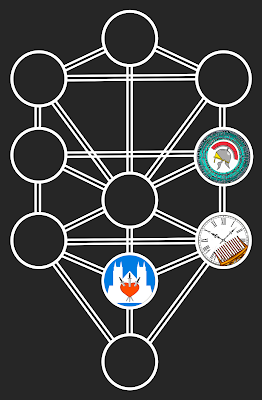
Thus, in the fourth spot down from the top (if you follow one tradition's "lightning flash" zigzag path), I place Rory Williams, the Last Centurion.


For readers who don't watch Doctor Who, Rory was one of the best characters from the 2010-2012 Matt Smith (11th Doctor) era.  I've waxed on about this Doctor, but not much about his human companions.  Rory started out as someone who got left behind, when his fiancee Amy Pond began traveling with the Doctor.  Then he turned into a bit of a joke about dying (and being brought back) multiple times.  But his shining moment was in the Season 5 episodes "The Pandorica Opens" and "The Big Bang," when he came back as an immortal (?) plastic (??) Roman centurion (?!?!) in the year 102 AD.  When Amy got trapped inside an impregnable cube called the Pandorica, which wouldn't open again until the year 2010, Rory realized that the only way to protect his one true love was to stand guard, and not waver, for the next two millennia.

The Doctor: Two thousand years, Rory. You won’t even sleep. You’ll be conscious every second. It would drive you mad.
Rory: Will she be safer if I stay? Look me in the eye and tell me she wouldn’t be safer.
The Doctor: Rory, you...
Rory: Answer me!
The Doctor: Yes. Obviously.
Rory: Then how could I leave her?
The Doctor: Why do you have to be so... human?
Rory: Because right now I’m not.
So, he waited.  And waited.  And became so much of a legend that museums had exhibits devoted to him.  I'll add another quote from one of those exhibits:

According to legend, wherever the Pandorica was taken, throughout its long history, the Centurion would be there guarding it. He appears as an iconic image in the artwork of many cultures. And there are several documented accounts of his appearances. And his warnings to the many who attempted to open the box before its time. His last recorded appearance was during the London Blitz in 1941. The warehouse where the Pandorica was stored was destroyed by incendiary bombs. But the box itself was found the next morning a safe distance from the blaze. There are eyewitness accounts from the night of the fire of a figure in Roman dress carrying the box from the flames.

My icon on the game board combines Rory's centurion helmet with the whirly circly pattern from the face of the giant cubical Pandorica.

I've always loved the trope of taking the goofiest of goofball characters and having them be the ones who choose to do the noblest, the most honorable, and the most difficult things for the sake of love.  Maybe we'll see more of this as the game progresses.  :-)

Thursday, December 23, 2021

Playing a New Game

It may no longer be the heyday of the blogosphere, but I still enjoy coming here, jumping into the river of ideas that's been flowing since 2011, and being Cygnus again for a little while.

Thus, despite having no idea who even reads this blog any more, I'm going to start a new project to exercise my Glass Bead Gaming muscles.  Back in 2014, I decided to take a break from the top-down design process and just play one of the existing game variants.  The result was the "Ode to Joy" game that started here, ended here, and has its intermediate moves listed here.  Let's try that again.

For those who haven't seen it before, I'll paraphrase some of the explanations from the beginning of that game here.  The idea, when playing by the late great Charles Cameron's Hipbone rules, is to lay down a pattern of interconnected cells, like this...

...then start "composing" a game by positioning specific ideas in each cell.  The challenge is to always ensure that neighboring cells (connected by lines) correspond to ideas that are interconnected in some way, too.  The ideas can be text, images, pieces of music, logical arguments, or references to other works of art or science.  The connections between the ideas can be whatever one wants them to be.

There can be competitive or collaborative games, where multiple people take turns claiming cells one by one.  In this way, they can challenge one another to find connections between wildly disparate or disjointed ideas.  My Ode to Joy game in 2014 had a bit of successful crowdsourcing for new ideas, but there's value in the solitaire exercise, too.

Okay.  The seeds of this game were planted last week, when I heard the song discussed below on the radio, and I started thinking about its other implications.  As of right now, I have tentative ideas for 8 out of 10 cells on the board, but that may evolve.  I'll try to post new moves about once a week, but we'll see what life has in store.

My first move is to place Hozier's 2013 song Take Me to Church in the second cell up from the bottom.

 
Those who recognize the board from Kabbalah may know this cell as the dreamy, emotional realm of Yesod, but that's not too important here.  My silly icon above is just a juxtaposition of a cathedral with the memorable central image of the Tarot's Three of Swords card, whose triply pierced heart indicates, well, the sweet heartache that Hozier hints at in the chorus...

I'll worship like a dog at the shrine of your lies
I'll tell you my sins so you can sharpen your knife
Offer me my deathless death
Good God, let me give you my life

If you've heard the song, you know the verses go even further, essentially equating the singer's beloved with the only deity worthy of worship.  I've been there, dear readers, I've been there.  The good Irish songwriter, Andrew John Hozier-Byrne, also tossed in some barbs at his own native Catholicism -- specifically the doctrine of Original Sin -- for good measure.  Suffice to say that worship-leaders appropriating this song for Sunday services may not be reading the lyrics closely enough.  This possibility of misinterpretation reminds me of when Billy Joel joked about "elevator-muzak" versions of his (minor-key) song Pressure that were transposed into a peppy major key.

Hozier's Take Me to Church, by the way, is in the key of E minor, which a 17th century music textbook called "amorous and plaintive."  Maybe that's true for my entire planned game.  We'll see.

Friday, June 14, 2019

Noctology

Okay, I know the worst thing you can hear from someone is "Hey, let me tell you about this dream I had last night."  But in this case, I hope you'll indulge me.  If anything, it's given me some cool stuff to think about.

In the dream, I was at a middle-school reunion.  That in itself probably seems kind of odd to many readers, since those don't seem to be common.  In the late 1970s, I think some administrators in my school wanted to out-Montessori the private schools or something, so they created a weird experimental class for some of the 5th and 6th graders.  Lucky me.  That first year, our teacher looked and acted like Annie Hall.  The second year, our teacher was an ex-priest who yelled at us a lot about our apathy.  We didn't really learn a whole hell of a lot, but I'm still great friends with many of those weird kids.

Okay, the dream.  I could name the four classmates I was sitting with at this imagined reunion, but I won't.  In that bit of subconscious reality, we had all become scientists of some kind, and we had just (in an hour or two of chatting at the reunion) made a major collaborative discovery about how the human brain works.  We managed to prove, conclusively, that the brain actually does make a permanent record of everything it experiences -- both external perceptions and internal trains of thought -- and that aging does not degrade that record in any way.

Unfortunately, we also proved that it's completely and utterly impossible to retrieve those records past a certain point.  Something about the brain carefully laying down layers of cells on top of one another, and you'd have to destroy the brain to peel them back.

But still, we showed (somehow!) that nothing is ever really lost.

The actual first moments of my dream were maybe just 10 or 20 seconds of happy chatting about the fame and fortune that would soon be coming our way, once we published our amazing discovery.

I didn't mention that the reunion wasn't just for our little nerdy group.  There were hundreds of people there from many other classes and years at the same school.  Jocks, too.  Dreams can be very cliched, can't they?  The jocks mounted a kind of mock "attack" on the nerds.

It was actually just a jokey pantomime of an attack; nothing truly dangerous.  Although it was meant in good fun, it still impelled our group to laugh along for a second or two, then grab our drinks and find some more peaceful place to chat.

Dreams being what they were, we found ourselves in a much older and decrepit part of the building hosting the reunion.  It essentially was a huge rickety barn filled with junk.  Have I been watching too much American Pickers?

Ever the nerd, I sought out the piles of old books.  In waking life, I've been working a lot on my teaching, so in the dream I found all kinds of useful resources.  Old textbooks.  A module for teaching the stuff that I'm teaching right now, but with the theme of the Netflix show Stranger Things.

I also found a set of astronomy books, but they were filed alphabetically under the letter N.  The reason is that some of them had the title "Noctology."  The study of the night.  I swear to you that I had never heard that word before, and a Google search tells me that not many other people have, either.

That's essentially the dream.

And I'm absolutely entranced by the idea of being a full-on Noctologist.

Sure, I've always been a stargazer.  Readers of the blog have seen plenty of sci-fi fandom here, and a bit of actual astronomical musing, too.  It's under the stars, and only under the stars, where I feel an immediate emotional sense of divinity. I look up, remember what it is I'm looking at, and I think "Oh yeah, that's right. I love you. How could I have forgotten since the last time I was out here?"

But noctology isn't quite the same as astronomy, is it? About 25 years ago, I was introduced to the folk singer John Gorka, and saw myself in "Good."
I am good at night
I am good at night
Sun don't fit me right
I tried with all my might
I am good at night
I am good at night
There are plenty of other musical paeans to the dark side like this.  One that I think is kind of interesting is inserted subtly in just a single line of Poison's hair-metal ballad "Every Rose Has Its Thorn."  You remember the line, don't you?  "Every night has its dawwwwn..."  For years, that line just passed over my head.  I assumed it was just conveying that old saw about it always being darkest before the dawn.  But look again, in context with the rest of the verse.
Every rose has its thorn
Just like every night has its dawn
Just like every cowboy sings his sad, sad song
Every rose has its thorn
Each line begins by talking about something good, then says how it can be ruined by one little flaw.  The night is the good thing, and the dawn is the flaw!  Good old Bret Michaels... closet noctologist.

I wonder how much more I should explore noctology as a frame of mind.  I kinda sorta started already a few years ago, with some thoughts on cosmicism.  There are traditions -- both real (Judaism) and fictional (Tolkien's elves) -- that start the new day at sunset rather than sunrise.  There's Mozart's star-studded Queen of the Night in The Magic Flute.


Technically, she's the villain, but she's also enough of a force of nature to snag the only slot for opera on Voyager's golden record that was sent out into the darkest reaches of space.

Nocturnes and aubades.  Night owls and early birds.  Nuit and Hadit.  Cherry red and midnight blue.

There's a lot there to ponder, and I don't have a crisp ending to bring it all together.  Maybe coming up with the perfect words is a concept more appropriate for the stars.  The night is okay with letting stuff happen, then layering it over with other stuff.  Nothing is ever really lost, after all.

Friday, December 28, 2018

Holiday Roundup

Ever since my new job started in 2015, this blog has definitely taken a back seat.  I'd like to try to reverse that a bit, and maybe by posting a quick list of highlights (from 2018) and wishes (for 2019), I can kick things into gear.  Anyway...

HIGHLIGHTS

1. A few months ago, I was hugely flattered and humbled to receive blog comments from one of my favorite authors.  The wonders of the internet...

-------

2. This year, an old classmate of mine from 5th & 6th grade (roughly ages 10-12 for non-US readers) joined Facebook, and we spent a few weeks over the summer reminiscing over the groovy late 1970s.  Digging into old boxes from that time revealed something else that I had forgotten:  As a kid, I once wrote to sci-fi author Arthur C. Clarke, and he wrote back!  It was just a form letter, but he added a few flourishes at the top and bottom...


For the life of me, I don't know why I didn't remember this when I wrote this post.

By the way, I'm not sure what the "P.T.O." at the top meant.  Clarke's letter came from his home in Ceylon... now Sri Lanka... so, maybe "Pacific Theater of Operations?"  Doesn't sound right.  "Please turn over?"  I think the sheets were typed on one side only.  Any ideas?

-------

3. This blog has gone into some oddball territory, but I'm not sure if I've ever talked much about my love of coins.  I never really amassed a huge collection, but I've always liked the history, symbolism, and lore.  I also have had a sweet spot for the pre-decimal coinage of Britain... you know, pounds, shillings, pence, farthings, and so on.  At two different times this year, I took a deep dive and constructed some interesting graphical images.  First, some nice visual examples of the classic types, with their amounts laid out clearly:


Next, after finding an auction catalog of weights of silver coins -- listed by monarch from the Dark Ages to the 20th century -- it was interesting to tabulate and plot how British silver money has been "debased" over time... i.e., how the amount of silver needed to make up one "pound sterling" got smaller over the centuries.  Here's the data:

Click on any of these to enlarge

Note the gradual drift downward from 1400 to the late 1600s... until Isaac Newton came in (as master of the mint!) around 1700 to bring together perception and reality!  There's also a mini-history of metal-working technology in this plot, too.  The spread of weights gets narrower over time, as mass production became more accurate.

-------

4. What do the following songs have in common?

The Who's Baba O'Riley, Slade's Run Runaway, BTO's You Ain't Seen Nothing Yet, and Rush's The Necromancer (final part: "Return of the Prince").

I'll attempt to hide the answer on your screen... just highlight the text to see it:

The majestic I-V-IV-[V]-I chord progression!  (That second [V] in square brackets is optional; just lengthen the IV if it's missing.)  I don't know why, but that particular progression does it for me every time.  Finding quasi-universal patterns like this is a fun side-quest in my search for a playable Glass Bead Game....


WISHES

1. Believe it or not, I'm still working on a piece of short fiction that I first got excited about in 2014.  The first draft is about halfway done, and I've gotten some feedback on that half from the best writer I know.  I've got my fingers crossed that I'll grab enough time to finish it this year.

2. Yes, I'm also continuing to add notes to my corpus (corpi?) of thoughts about: (a) the Glass Bead Game, and (b) my own D&D retro-clone Homebrew '82.   Low low priority these days, but still going.

3. I've been slowly working my way through the 33 short stories in Dangerous Visions, the ground-breaking book edited by the late Harlan Ellison and published the year I was born.  This anthology exemplified the "New Wave" of the time, and it was only this year -- after collecting Harlan's works for the past few decades -- that I found a copy at a used bookstore.  As I read each one, I'm writing spoiler-free mini-reviews, and ranking the stories into 3 groups (skip, okay, wow).  I'll publish them on the blog when I'm through the whole thing.

4. I'm kinda sorta still doing tumblr, even after the controversial purge of NSFW content earlier this month, but I'm mainly just collating and reblogging stuff I find cool.  I'll occasionally scan images from old comics or magazines that I haven't found online, or maybe post some of my numismatic musings (see above), but I'm not a super-user by any means.

I hope everyone who got to the bottom of this post has an awesome 2019!

Saturday, May 12, 2018

Give me Star Trek (Cygnus version)

Six months... probably the longest the blog has gone without an update.  I really want to be posting here most often, but life is busy.

A week or two ago, I saw an interesting Star Trek related meme by someone named Skye Gray (but it's hard to pin down its true origin).  I thought it really got to the hopeful heart of the franchise.  However, Discovery wasn't represented -- meaning it was probably made prior to 2017 -- and there were a few pieces of the puzzle that I didn't quite think were optimized.  Thus, I made my own version... 

Click for dreadnaught-sized

Trek fans may find aspects to complain about (Pine and not Shatner? Broccoli for Courage?) but I stand by my choices.  Share if you like, and live long & prosper.

Sunday, November 5, 2017

Tumbling into New Media

The blog's been a bit quiet lately... not so much because of lack of things to say, but mostly just work & life doing their thing.  I am mulling over long-term plans for the 2018 April A-Z Challenge.  If it happens, some fraction of it will be a serialization of the story that I started writing about 3 years ago and haven't talked about much since.

Focusing on the here and now, I've also (impulsively) decided to give tumblr a try.  "Another blog?" you may say, "You can't even keep up with one, dude!"  Well, the tumblr format is a little more "micro" than what I'm used to around here.  For some reason, I associate this blog with archiving my long-form deep thoughts.  Many ideas come and go because they can't be expanded into something that I think is servitorludi-worthy.  Tumblr is also more about quick reblogs and memes.  Those can still be deep and impactful, but there's less of a mental cover-charge (at least for me).  Thus, let me introduce My Own Weird Way...

https://myownweirdway.tumblr.com/

Before anybody asks...
  1. Yes, the title is based on a line in the song Santa Monica by Everclear.  I'm not a rabid fan of theirs or anything (though I always loved that the lead singer was a guest actor on "Ned's Declassified"); I just always kind of liked that line.
  2. The header image is the Cygnus Loop (duh), with overlaid hexgrid and Star Fleet Battles counters, just for kicks.
So although I may occasionally do tumblr things about the main topics of this blog (Glass Bead Games & Role Playing Games), I'm planning on being much more free-range with my fannish & esoteric interests.

In other words, I have no idea what will show up there, but it's going to be fun & interesting!

Wednesday, August 23, 2017

Bright lights, big geekery

For those times when a fully thought-out post is too much for each topical tidbit, there's the "five things make a post" post!

1. My family and I were lucky enough to be within driving distance of the Great American Eclipse on Monday, so we went on the moonshadow quest.  We didn't spend our precious 2 minutes and 25 seconds taking crappy cellphone pics, since we knew the professionals were out in force.  Here's an example from someone from NASA's Marshall Space Flight Center:


If you can wait a bit, you should check out what Dr. Miloslav Druckmüller (arguably the best eclipse photographer in the world) will have to show for his trip to the States this week.  It may be another month or two before he posts his results, but trust me, they'll be worth the wait.

Should I join the thousands of others who are having trouble putting their experience of totality into words?  It was my first one, and I can honestly say it was a hugely different experience than looking at pictures online.  Truly remarkable.

= = = = =

2. I'd been getting out of the habit of reading novels lately, so a few weeks ago I decided to catch up on a reputed sci-fi classic.  I devoured Dan Simmons' Hyperion (and its second half, The Fall of Hyperion), and came out of it pleasantly enchanted by his vision of humanity in the year 2852.  I liked the "Canterbury Tales" framing vibe of the first book, and how he broke out of it in the second.  After hearing that a TV miniseries may be in the works, it got me thinking about a "dream cast" of actors who could portray Simmons' memorable characters.  I'm planning on reviving my YouTube channel and creating a slideshow video to illustrate those choices.  Fun!

= = = = =

3. A little more than a month ago, I was also fascinated by a serialized story posted online, titled "17776: What football will look like in the future."  I'm not a football fan, but this story was about much more than the gridiron.  If you want your mind blown, I won't say another word.  Just click on that link and don't be prepared to come up for air for a while.

= = = = =

4. The internet has allowed many of us to indulge in nostalgia in lots of different ways.  I forget how I came across it, but I found a description of a series of children's encyclopedia books that my Dad had when he was little.  The Vintage How and Why Library was published in the 1930s and 1940s, and I got to read them when I was a kid in the 1970s.


Nothing substantial to say, other than the most memorable bit being the Art Deco style renderings of majestic gods and men.  Also, don't let anyone tell you that elves with those swept-back ears were an invention of 1990s video games!  :-)

= = = = =

5. Speaking of the 1990s, here's some more nostalgia:

-----BEGIN GEEK CODE BLOCK-----
Version: 3.12
GS d !s a+ C++ U+(-) !P L+ E--- W++ N++ o-- K w !O M V
!PS !PE Y+ PGP t+ 5+++ X+ R+++ tv+ b+ !DI D--- G e++++
h---- r+++ y++++
------END GEEK CODE BLOCK------


The above is my carefully constructed Geek Code, which is supposed to help others size me up in a single glance.  (I'll pass over the well-trodden irony that this gives the once-excluded the tools to become the excluders.  In practice, I think nearly everyone who used this code used it to find kindred spirits.)

I've (kinda sorta) wanted to make this for almost a quarter of a century, but I never did it back in the day.  The above string of identifying marks is brand new, but it's weird that the definition of the code hasn't been updated a long time -- so long that its home page has expired and the above link goes to a saved page at the Internet Archive!  Although most of the items are true for 2017-Cygnus, I did have to scratch my head a bit to recall my fine-grained ideological stances on the VMS operating system, Kibo, and the X-Files.  :-)  On a few of these things, I had to punt.  I used the exclamation point (!) to mean either "this thing is so foreign to me that I have no idea" or "it's just none of anybody's bidness."

Saturday, January 28, 2017

Apollo Mnemonic

Why do I do the things I do?

You won't find the answer to that question here, just one of the things.  :-)

Last week, I was sad to hear of the passing of Gene Cernan, the last astronaut to set foot on the Moon.  That got me thinking that I've always wanted to have the names of the Apollo astronauts memorized.  Growing up, they were always quite important to me, but I think I could have only rattled off the crews of Apollo 1 (whose fatal fire just had its 50th anniversary yesterday), 11 (duh), 13 (because of the movie), and then just Cernan from 17 (for his special final status).

Again, I don't know why I would want to memorize them all, but I've done similar things in the past.  I once could recite the names of the first two centuries worth of Roman emperors in order, and also the names of the 20 divisions of the Mayan tzolkin calendar.  Maybe a few other lists that I've, um, now forgotten about, too.  :-)  It's not like I ever made a public show of that knowledge... it's just that I liked knowing it.

Anyway, I still don't know if I'll try to cram these astronaut names into my memory, but I did have fun creating a one-page "cheat sheet."  If I go ahead and try to memorize, I'll stick this in my pocket and refer to it as I study.  I looked around for something similar, but all the other infographics were either too busy (i.e., wouldn't look nice printed on paper) or didn't contain what I wanted.  I jazzed it up a bit with the mission patches and the informal call-signs for the ships, and I thought I'd share it here:


Clicking on the above gives you a medium-resolution JPG image.  I've also put a nicer PDF version at this Google Drive link.

Hey, if I can't use this blog to share the fruits of my weirdness, what good is it?

Friday, November 18, 2016

Atlas of Oddities, Part Deux

Here's the sequel to the blockbuster prequel...  3 maps down, 3 to go.

In my 2013 April A-Z post on author Somtow Sucharitkul, I mentioned his alternate take on a Roman empire that conquered (or tried to conquer) the New World.  His original "Aquila" short stories were published in Asimov's Science Fiction Magazine in the 1980s, then later packaged into novels.  However, the novels didn't contain this gem of a map from the April 1982 issue of Asimov's!

Click to Maximus... er, maximize

I had to dig through a few boxes to find this one, but once I realized it wasn't online anywhere (at least anywhere easily searchable), I was determined to rescue and digitize it.  The map credit at lower left reads "J. R. Odbert."  I think most of the Latin puns are taken right out of Somtow's story, but I wouldn't put it past a crafty cartographer to insert more.  As I remember, a lot of the story takes place in and around the city of Caesarea, which I think is sitting where Omaha, Nebraska ought to be.  This is not your paterfamilias' Terra Nova!

The last two maps are things I've drawn.

Several times on this blog I've waxed on about my love of David Zindell's awesome first novel Neverness and its sequels.  I even wrote a fannish Travel Guide to his intricate and uplifting constructed universe -- which I heartily recommend to anyone about to read the books for the first time.  No spoilers in there!  Much of the action takes place on the largest island on a chilly planet named Icefall.  Zindell didn't include a map of the place, but I did my best to piece together something that could help readers navigate around...


I think my MS Office art skillz have matured a bit since first making this in 2011, but it does the job.  I do need to note that the TV show Family Matters didn't exist when Zindell came up with the name of that southern-most mountain, but I wonder if he found it a minor source of embarrassment when writing the sequels...

Okay (gulp), the final map today is something I drew back in the 1980s.  When my friends and I played D&D, we took turns running the game, and we each took control of a continent on a larger world.  We blithely ignored the realities of such a setup, and each new adventure usually started with something like "As you're disembarking from the ship from Brian's continent, you see...."

Anyway, here's mine.  I did my best to enhance the image, but the original is very lightly-drawn pencil on notebook paper...


I suppose there's a symmetry between my "Ponténar" with the mythical "Poseidonis" that I talked about in the previous post.  I originally designed the coastlines by tracing over a map of the Mid-Atlantic Ridge, and imagined a whole Greek-themed Atlantis-ish empire in the southern part.  I eventually added some extra land up in the north, because my actual contour of the Mid-Atlantic Ridge just didn't have enough surface area for everything I wanted to squeeze in.

Unfortunately, I never got to tell the stories of many of the places on this map.  Invorum up north was a hidden stronghold of powerful wizards.  The unfortunate dwarfs of Felak-Gizan were enslaved by the Tachyran empire, and were soon going to get their revenge.  See that island in the bay between Tachyra and Yaxaan?  The volcano on that sucker was going to cause trouble for hundreds of miles around.

As I look at the place names in my map, I also see a litany of morphed names of people that meant a lot to me back then.  I'm not going to tell you who Meaghra, Rendin, Gyule, and Kalapis are named after, but each one gives me a lump in the throat.

Ah, well.  I think counter-factual maps like these are tempting vessels for us to pour in our weird, wild thoughts & dreams... and mix them up in ways that sometimes surprise even the mapmaker.

Sunday, November 13, 2016

Atlas of Oddities, Part 1

Psst... hey... want to see some weird maps?  I've done this once before, and now I've got six more to share... this time including a few of my own creations.  But I realize that my blog posts tend to be loooong... so I'll split it up.  Just three maps here, and three to come later.

Back in the summer, I posted about my childhood obsession with UFO pulp magazines of the 1970s.  "Weird, wild stuff," to paraphrase Johnny Carson.  Looking back through them, I did find one interesting alt-history-ish map of an antediluvian world that hosted the lost continent of Atlantis, as well as... the land of Oz...?

Click on all these for bigger versions.

The article, from Ancient Astronauts Special (Summer 1978), was called "Atlantis Reawakened."  I can't quite find an author byline for the article, but the map contains an artist's signature on the lower left that I can't quite make out.  The story talked about Dogma, the doomed daughter of King Chronos of Poseidonis (also doomed).  Concerning the map itself, I'm a little scared to ask why northern Africa was called "Teutonia," but I'm fascinated by them placing the "Land of Canaan" up near Hudson Bay.  Still, calling Atlantis "Poseidonis" is quite poetic, don't you think?

An interesting bookend to the above is Jack Kirby's future world of Kamandi.  I didn't read those comics back in the 1970s... nor have I read them since... but they seem like a crazy ride:


On the heels of the success of the Planet of the Apes franchise, DC Comics was looking for a similar post-apocalyptic story with humans in the beleaguered minority.  But one simply doesn't give Jack Kirby the job of doing a knock-off story.  What he gave them was orders of magnitude weirder.  I wonder if this far-future world was an influence on the world of "Ooo" in Pendleton Ward's Adventure Time.

Speaking of DC comics, I clearly remember this map of Superman's home planet of Krypton from the comics of the Silver Age:


I simply do not accept any more recent revision of the planet Krypton that doesn't contain the Gold Volcano, the Jewel Mountains, or the Glass Forest.

Whoops, none of my own maps made it into this post.  Stay tuned!  :-)

Saturday, June 25, 2016

Assyrian Ancient Astronauts?

Once again, I'm caught between two conflicting desires.  On the one hand, I want to write about something weirdly oddball and unique -- something special to me, something that seems to have no other home on the internet that I can find.  On the other hand, I don't want to make it look like I'm making fun of this strange little cultural artifact.

(Above, I said "once again" because I've done this dance before.  I'm still not sure I should have written about the infamous Alphabet of Neptune.)

Sigh.  I'll proceed, hopefully with enough caveats to show that I don't want to belittle anyone's beliefs or put down the creativity of a hardworking writer.

What's this all about?  The UFO craze from the 1950s to the 1980s led to some interesting publications.  As a teen growing up in northern New Jersey, we saw a lot of colorful pulp magazines from New York City that I'm not sure made it to other parts of the country.  I couldn't get enough of "Official UFO," which often contained long-form treatises about how to spot hidden aliens, Elvis' posthumous life in hiding, and all forms of visitations and abductions.  But something in the April 1980 issue of spinoff magazine "Ancient Astronauts" caught my eye...


See that blurb at the bottom?  "Cosmic mystery of the Assyrian poem!"  The article inside talked about a recently discovered clay tablet, translated by esteemed archaeologist Irwin Wilson (of whom the internet has no memory), and which proves beyond the shadow of a doubt that the ancients had astronomical knowledge only obtainable from contact with space-faring beings.

I'm being snarky.  Apologies.  My teenage brain kind of believed it (i.e., really wanted to believe it), while simultaneously realizing it must be a pure fake.  I kept the hopeful dissonance alive for several years.  As a result, it's been firmly lodged in the back of my mind for three decades.  Seeing it nowhere else on the web, I feel the need to preserve it.  Like a clay tablet buried beneath the shifting sands, maybe?  I won't reproduce the whole article, but I will show a scan of the first page, then transcribe the actual poem with some astronomical commentary on each part.

Click to enlarge

The "poem" is a list of ten children and their characteristics.  The idea is that they're metaphors for the planets in our solar system.  There were things there that ancient humans couldn't have known, but were only discovered "recently" (by 1980).  The kicker would be to find things in the poem that weren't known in 1980, but are now.  Let's search!

The first child, fleet and warped, shall by his mother be consumed in flame.

Mercury is the fastest moving planet.  I don't think it's particularly "warped" in shape, but its orbit is modified by the gravitational warping of spacetime so near the sun.  We're pretty sure that in 5 billion years or so, it will be the first planet to be engulfed by the dying sun.  All this was known in 1980.  :-)

The second child, though known as beauty, shall be found a cursed thing. Poison and strangulation shall lie under her diaphanous gown. Liar is her name.

A little harsh on poor Venus, don't you think?  Sure, its atmosphere turned out to be dense and highly toxic.  But before that, all we had was Edgar Rice Burroughs and his phantastical dreams of a tropical paradise under all those clouds.

The third child, brother to them all...

Interesting choice for Earth to be gendered male, while the Sun is female.  Note that this line tags the word "brother" to refer elsewhere to humanity and its home.

The fourth child, angry eye of war, shall be a disappointment. No kin of kin to brother after long hope. His face is broken, four boils shall wash his face with tears.  Yet, he shall one day be known as hope.

I guess the Viking missions to Mars in the late 1970s were a bit of a let-down to baby boomers, for whom the terms "space alien" and "Martian" were almost synonyms.  The 1970s also saw the first detailed maps of Martian geography, which included the Tharsis plateau and its four huge volcanos (boils).  "Hope?" Nah, he shall one day be known as Mark Watney.

The fifth brother, lost to his brother, was by his mother most joyously born. All blessings and gladness did he receive and he shall be long remembered by _______ (The name or term cannot be translated -- I.W.) He is broken now and his body has been eaten by his kin -- to their delight or despair. His memory shall one day return.

Now it gets interesting.  The fifth brother seems to be the putative progenitor of the asteroid belt, which some used to call Phaëton.  Trouble is, the astronomers have pretty much come to universal agreement that the asteroids were never all joined into a single planet.  They just are remnants of the original "planetesimals" that were there at the start of the solar system.  Maybe asteroid mining will someday help bring all this rapturous joy back to the brother!

The sixth child is father to the mother and will rage like her. His children offer much hope to the brother, a link to _______. In the years he will feed his brother. He shall wear a crown but lightly, a mock to brother next. He apes his mother and so he must burn.

Big burly Jupiter is often thought of as a "failed star," but it's really nowhere near massive enough to "rage" like the sun.  The Voyager probes visited Jupiter in 1979, and found all sorts of surprises on its moons -- from ice floes on top of water oceans (Europa) to the most active volcanos in the solar system (Io).  Voyager also discovered a faint, dinky ring system.  Nothing in comparison to Saturn's crown, of course.

The seventh child, both fat and squat, bears a glorious crown and shall be loved by his brother for his first child. The child is faith to brother and will give up treasures to all. Blessed be the child of the seventh! He shall quench the angry eye of war and melt the tarnished sword.  The seventh keeps his child warm.

Saturn is the most oblate (slightly hamburger shaped) of the known large planets.  But what's all this about its first child, Titan?  Our Assyrian friends heap so much praise on this little moon!  In the 1970s we knew about its thick atmosphere, but it wasn't until 2004 that its liquid hydrocarbon lakes and rivers began to be mapped.  What it's got to do with Mars (the angry eye of war), I have no idea.

The eighth child, merriest of them all, shall turn his bald pate to his mother. Tipsy, he shall dance with his children where he lays.  He shall be crowned, but lightly.  His name shall be mystery.  Beyond sight of brother ... to follow his turning to the right star.  Immortal is his form.

Oh, come on.  Uranus is just merry because of the infinite puns made about its name.  It does orbit around an axis tilted at roughly 90 degrees from where it ought to be -- and it's got a faint set of rings -- but we knew that stuff in the 1970s, too.  Uranus was the first of the "modern" planets discovered via telescope, so it's only "beyond sight of brother" to the naked eye.

The bits about "to follow his turning to the right star," and immortality, intrigued me a lot.

The ninth child, terrible is his name, is the step but last to infinity. Lost of crown, lost of son, he shall be eclipsed by child stolen by broken kin. At his end shall be found by brother the new beginning...
 

The ninth is Neptune, and his "lost son" is probably meant to be Pluto.  I'm pretty sure the idea that some cosmic collision resulted in Pluto's ejection from Neptune's gravity was being talked about prior to 1980.  Pluto's weird orbit sometimes takes it closer to the sun than Neptune.

"Lost of crown?"  Nope, it turns out Neptune does have a faint ring system like the other gas giants.  Wikipedia says it was first discovered in 1968, but I don't think it was widely known until much later.

The tenth child, cold be his name, is slow and blind.  No heat there is for him.  Tiny are his children.  He wears no crown.  For many ages unknown will he be to brother.  He throws combs at his mother for her ingratitude. His brother shall know him when he takes his eyes from his face.

Here's Planet X.  Or, maybe Planet IX now that we've renumbered.  In the last year or so, there have been some tantalizing hints that there really may be a massive planet way out there, though the idea of it has been in circulation for almost a century.  If it exists, it may alter the orbits of some other asteroids, but it's not the same thing as the Oort Cloud (which does appear to send "combs" into the inner solar system).  "Eyes from his face" may refer to space telescopes?

The eleventh child...  (Here the manuscript breaks off.)

Oh, those Assyrian teases.

In hindsight, yes, this was hokey and silly.  It doesn't really pass the basic test of predicting things that weren't known in 1980 but are known now.  If only it talked about hexagonal clouds on Saturn, dried river beds on Mars, heart-shaped blemishes on Pluto, or pillars of salt on Ceres!

However, I've got to give it to the writer (listed as "Mark Matthews," but I wouldn't doubt pseudonyms were common) for assimilating so many contemporary astronomical discoveries into the world of myth.  This helped my teenage mind soar into the outer heliosphere, that's for sure!

Wednesday, June 15, 2016

Alchemy: can an app make art?

I've talked a bit about the dream of making a real-world version of Hermann Hesse's Glass Bead Game.  The goal of this game is essentially to make art out of art... and out of science, and just about anything else.


In order to juxtapose and transform ideas of all kinds, one needs a common language.  Hesse was vague about the symbols and glyphs he imagined the Game Players using (i.e., definitely not literal beads!), but he knew the game's "language" had to be able to describe just about anything:
"A Game, for example, might start from a given astronomical configuration, or from the actual theme of a Bach fugue, or from a sentence out of Leibniz or the Upanishads, and from this theme, depending on the intentions and talents of the player, it could either further explore and elaborate the initial motif or else enrich its expressiveness by allusions to kindred concepts. Beginners learned how to establish parallels, by means of the Game's symbols, between a piece of classical music and the formula for some law of nature. Experts and Masters of the Game freely wove the initial theme into unlimited combinations."

Some modern-day Game designers have tried to punt on this issue in a clever way.  In our internetworked age, don't we already have a universal language?  Consider computerized 1's and 0's:  they can be combined to form ASCII characters, or full-color bitmapped JPGs, or nice-sounding MP3's.  Any existing work of art or scientific theorem can be reproduced with just the right combination of on's and off's.

That may be the practical answer, but it doesn't seem like the most elegant one.  I guess I'm still hearing the same inner voices that compelled Leibniz and Wilkins back in the 1600s.  Couldn't there be a universal way of more directly symbolizing all the disparate ideas that the human mind can dream up?

The reason I'm writing this post is that I've come across something kind of new (but also kind of ancient) that has me thinking more about this issue.  Insight has come from an Android app!

Someone named Andrey "Zed" Zaikin created Alchemy, a game in which
"You have only four basic elements: Fire, Water, Earth and Air. Combine them and their products to get more than 300 new elements. You can create a Life, Beer, Vampires, Skyscrapers and much more."
(Note: this post is not an advertisement.  Although I've searched for many details about this game, I haven't yet downloaded or played it.  I can't vouch for the product itself.)

It's such a simple concept, but it's a fantastic example of building an ontology of ideas out of just 4 fundamental concepts.  At the risk of "spoilers," let me just give a few examples of the successive build-up of complexity that it allows:

lava = earth + fire
stone = lava + air
sand = stone + air
beach = sand + water

Of course, you can eventually get to Gold -- as well as Yoda, Batman, and the Kama Sutra -- but I won't say how.

However, I'm not quite sure where to go from here.  (I guess I say that a lot in these kinds of posts!)  I'd pay good money for a dictionary of thousands of concepts, each constructed in the above way.  Especially if those concepts included the basics of music theory, narrative tension, postulates of pure math, foundations of modern science, and so on!  Am I up for writing such a thing myself?  Probably not...


...barring any future thunderbolts of polyfugual enlightenment, of course!  :-)

Thursday, December 17, 2015

Star Wars Eve

My family and I may not be going to see the new Star Wars movie until early next week, but the premiere of Episode VII is nearly here!


In honor of the occasion, I wanted to give you fine nerf-herders a few interesting links...
  • I put up a new video on the Cygnus Youtube channel, with text from the evocative post about Luke Skywalker that I blogged about this past April.  (Hat tip to Fialleril for writing such great words!)
  • If you're an old-school D&D player and would like to role-play adventures in a Galaxy Far Far Away™, I propose avoiding all licensed games.  Just go download a copy of Encounter Critical, and staple on Jeff Rients' super-awesome Star Wars campaign guide from a blog post back in 2010.  (For added context, see two earlier posts that describe Jeff's motivation, here and here.)
  • When I was first exploring the Internet in the late 1980s, I came across a script titled "Star Wars Episode III: Fall of the Republic," written by someone named John L. Flynn.  It's essentially fan fiction, but at the time there was nothing like this in existence.  Go read it!  No worse than the prequels, I say.
  • I wasn't a subscriber to the original Star Wars Fan Club Newsletter ("Bantha Tracks"), but my best friend in 1978 was.  I enjoyed leafing through those things when they'd arrive... getting the inside scoop on what "Star Wars II" would be about.  Someday I'll have to get my hands on some old copies to relive those times.

  • Lastly, I think I may have already blogged about my experience with an, um, less than reputable mail-order publishing house.  In 1982, on the heels of Yoda's wisdom, I sent away for a book (advertised in the back of Starlog magazine) called "The Teachings of the Force."  Darn thing never came.  The P.O. box was in a town just 45 minutes away... and my Dad worked in our local post office... so he drove me over there.  We tried to learn what we could learn.  No dice, though; the perps were long gone.  Still, if anyone out there happens to know if the following thing actually exists, I still would like to know more...  :-)
Redacted, der.

May the Force be with you all, this fine holiday season!

Update:  Saw Episode VII on Sunday!  Woo-hoo, that was some Star Wars.

Monday, December 7, 2015

Whose Tube? My Tube!

The day is here.  Here is the big announcement:  I've started a YouTube channel called "Cygnus' Magic Words."

https://www.youtube.com/channel/UCGAqpg-eqicLiaFwQW-iZKA/

The URL may change eventually, but for now it's the following mush of characters:
https://www.youtube.com/channel/UCGAqpg-eqicLiaFwQW-iZKA

The tag line is "Magic words for the soul."  More from the channel description:
Since 2011, I've been blogging at servitorludi.blogspot.com about games, philosophy, and whatever other weird bits of esoterica I can think of. I'm no master of the Game, just a servant who wants to see what the future holds for both the high-concept stuff (like Hesse's Glass Bead Game) and my old favorites (classic tabletop roleplaying games like D&D).

Here on Youtube I'm exploring another aspect of that weirdness: the magic of WORDS. On my blog I've posted a lot about my favorite creative people, many of whom are wordsmiths of some sort. Posting excerpts of text is fun, but sometimes the words need to be heard by the ear. Sit back, close your eyes, and see how the words will change you.
Right now I've got four videos up.  You won't see me directly, but you'll hear me reading a variety of things -- both poetry and prose -- that I hope will inspire and move you.  What you'll see with your eyes, in most videos, is a sequence of Kandinsky-like artworks that I've generated via a randomizing computer program.  Why?  No reason other than it was fun to make.  (I'm not the first person to think of doing this, but I haven't cribbed from anyone else's algorithms. I'm still tweaking and optimizing.)


That's all for now.  If you're inclined, go have a listen.  Please let me know if there's anything that you'd enjoy hearing, too.

Friday, September 25, 2015

Won't you please?

Won't you please?
Please won't you roll... for initiative?

Hat tip to the Old School Roleplaying FB page

In a way, it was the perfect gateway drug for RPGs and other imaginatory pursuits.  A trip to the Neighborhood of Make Believe every day?  Who could ask for more?  And given that land was filled with kings, trolls, witches, talking animals, and aliens from the Planet Purple (I'm lookin' at you, Arneson's Blackmoor) I see no incongruity here.

- - -

More content soon, folks.  This blog ain't dead yet!

Monday, June 15, 2015

Venus Paradise: Cyber Edition

I'm still not done thinking about the long-term goals of this blog, but there is one idea for a post that I've had for a few months, and I'd like to get it out there.  Does anyone remember these?


Some time in the early 1970s, I got a few of these color-pencil-by-numbers sets as Christmas gifts.  For young Cygnus, the color pencils were a godsend.  I loved the ubiquitous Crayola rainbow, but wax crayons left a lot to be desired.  They couldn't give you the fine lines of a pencil or pen... and if you stacked up a few of your creations on top of one another, the papers would stick together and get kind of goopy after a while.

I was fascinated by one particular brand... the Venus Paradise pencils, which had their own unique color palette.  Each color was assigned to an evocative name and a specific number in an esoteric sequence.  The numbers corresponded to the digits on the color-by-numbers outlines, but I don't remember filling in many of them.  I tended to just hoard the pencils and draw other stuff with them (and I still have some nubs left in a box somewhere).

 
So, a few months ago, I discovered a massive, labor-of-love web site for Crayloa crayon collectors.  Over the years I've also seen quite a few attempts at creating web-based color palettes out of the classic crayon colors.  But where's the digital love for Venus Paradise?  Someone might want to re-create their childhood color-pencil artwork as accurately as possible.  Okay, Cygnus (plus some image-grabbing software) to the rescue.

1. Deep Yellow:  (247, 210, 039),  #F7D227
2. Sarasota Orange:  (245, 120, 057),  #F57839
3. Poppy Red:  (231, 067, 069),  #E74345
4. Hollywood Cerise:  (255, 111, 145),  #FF6F91
5. Orchid Purple:  (089, 062, 103),  #593E67
6. Navy Blue:  (022, 057, 108),  #16396C
7. Peacock Blue:  (078, 195, 239),  #4EC3EF
8. Emerald Green:  (036, 179, 134),  #24B386
9. Deep Chrome Green:  (024, 092, 069),  #185C45
10. Photo Brown:  (136, 068, 032),  #884420
11. Chestnut Brown:  (067, 047, 026),  #432F1A
12. Midnight Black:  (017, 017, 016),  #111110
13. Ultramarine Blue:  (059, 123, 210),  #3B7BD2
14. Natural Flesh:  (246, 224, 181),  #F6E0B5
15. Lawn Green:  (056, 134, 079),  #38864F
16. French Green:  (203, 215, 087),  #CBD757
17. Smoke Gray:  (159, 153, 146),  #9F9992
18. Blush Pink:  (251, 133, 126),  #FB857E
19. Cherry Red:  (217, 057, 064),  #D93940
20. Arizona Topaz:  (243, 208, 119),  #F3D077
21. Indian Red:  (174, 064, 042),  #AE402A
22. Sky Magenta:  (208, 123, 154),  #D07B9A
23. Cotton White:  (254, 253, 253),  #FEFDFD
24. Lemon Yellow:  (253, 243, 132),  #FDF384
25. Bright Gold:  (195, 170, 117),  #C3AA75
26. Bright Silver:  (155, 185, 190),  #9BB9BE
27. Sky Blue:  (104, 192, 236),  #68C0EC

I so love those color names.  If I ever write a noir-ish crime drama, I'm sure I'll steal at least three or four character names from the above list.  I think #4 and #17 must be having an affair.

Here's what the digital RGB colors look like in graphical form:


Please do whatever you like with this information.  I'm still not sure why it's ending up on this blog.  I just know I had a blast putting it all together.  Right now, that's enough for me.

I should note that I never owned numbers 25 or 26.  According to the web, these two were the rarest colors of the bunch.  It took me a while to even find an image of #26 (see below... ain't it bee-u-tee-ful?).  For #25 I had to go slumming with online images of other brands to even begin to guess what "Bright Gold" might look like.  I'll find one someday!  :-)