Showing posts with label GBG. Show all posts

Friday, February 21, 2025

The New Game: Completed

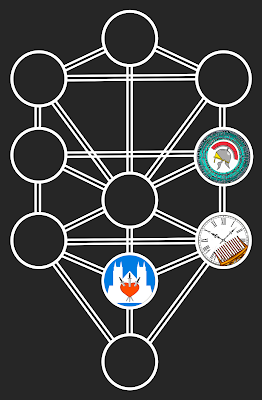
With huge apologies to anyone out there who has been waiting for this, I'd like to bring to a close the TenStones Glass Bead Game that I started in December 2021.  In blog posts since then, I added four shiny stones to the board.  Since I really wanted to post this post today, I decided to sum it all up and briefly present the remaining six stones.  Here's the full board:

 
Going from bottom to top, I'll list all ten of the shiny baubles and give links to the earlier posts...

  1. At the bottom is Ad Orientem (move #4), with thoughts about how we try to orient our souls in the right direction.

  2. One up from the bottom is Hozier's Take Me To Church (move #1), which illustrates how "the right direction" sometimes takes the form of an idealized other person.

  3. On the bottom right is O Henry's Gift of the Magi (move #3), further pounding home the point that self-sacrifice is a key that can unlock the doors discussed above.

  4. On the bottom left is the first of today's new beads, which I suppose I can call Inversion (or maybe "The Upside Down").  In life there are often false dawns, feasts of fools, Yin's inside Yang's, and other times when everything seems flip-flopped.  Traditions around the winter holidays include Saturnalia, the Lord of Misrule, and Boxing Day... often with temporary swaps between the people in charge and the ones who do the dirty work.  My mind goes also to Hawthorne's Young Goodman Brown, who ominously sets out on his journey at dusk instead of the usual dawn.  Or Sheryl Crow's "All I Wanna Do," in which the protagonists flout convention by drinking beer at noon on Tuesday.  The connection to O Henry is "right idea, wrong time."  The connection to Hozier is "no masters or kings, when the ritual begins."

  5. At the center of it all is an enlarged bead in which I deposit Liebestod, the love-death.  (Why was I on such a roll with this loving self-sacrifice thing?) The image includes the alchemical pelican, who supposedly pecks itself to bleed in order to feed its children.  Is this the central heart, the ground-zero, of what it is to love?  Or does it go too far?  In my 20s, I know that I read way too much Joseph Campbell, and he made far-ranging connections between Wagner's Tristan & Isolde, Christian mysticism, and the way that knightly chivalry essentially redefined the concept of romantic love in the middle ages.  Is AMOR an inversion of ROMA?  Don't know, but I suspect that it wins even when it loses.

  6. Above and to the right of center is good old Rory Williams, the Last Centurion (move #2).  Who doesn't love Rory the Roman?  Jerks, that's who.

  7. Above and to the left of center is some combination of Indigo and The Blues.  This was the last puzzle piece to be filled in, and I'm still not quite sure about it.  There's a century of sadness in this musical genre based on flattened notes and minor keys.  I've heard that one reason that the color blue is associated with melancholy comes from certain African cultures in which one wears indigo-dyed clothing when in mourning.  (The image is from an online museum exhibit of those fascinating textiles.)  I'm pretty sure Blue Mondays are a necessary element of the Game, though.  If we have free will, it demands the possibility of mismatches in feelings... and you know where those can lead.  The connections with Liebestod should be clear.  Inversion?  Well, they say Robert Johnson had a similar adventure as did Young Goodman Brown.  Rory the Roman felt down & out quite a few times, too, but I don't think he'd ever think of erasing any of those moments across space & time.  I've said much more on this.

  8. At the top-right is the Freemason's symbol of the Rough Ashlar, the rough-hewn raw material that each of us have as we set out on our moral journey.  Some compare it to "the stone that the builders rejected," which eventually becomes the cornerstone of the temple.  (Jesus wasn't playing around when he whipped out Psalm 118...)  You've got to learn to spot the good stuff when you see it, despite its outer appearances or circumstances.  This also reminds me of that old song "Swinging on a Star" -- yes, the one with the mule and the pig -- which isn't playing around either when it says you can be BETTER than you are.  The link to Rory is the cubical Pandorica.  The link to Liebestod is that all this hewing is what makes you worthy of someone else.

  9. You'll know what's at the top-left if you zoom in on the image.  Yup, it's The Matrix, the movie from 1999 that introduced a lot of us to some interesting byways of philosophy, including the "simulation hypothesis" and transhumanism.  However, here I'm thinking more about the boots-on-the-ground choices that many of the characters needed to make:  Is the life I'm living as real & authentic as it could be?  Are dull illusions better than dangerous reality?  Is that mysterious other person... The One?  The link to deepest Indigo is mostly vibes... the dark glasses and goth discontent.  The link to Liebestod is everything Neo & Trinity did for each other.

  10. Who's that at the top?  If you know your Al Hirschfeld Playbills, you may recognize Dulcinea, also known as Aldonza, the female lead of the musical Man of La Mancha.  I'm not going to provide a full plot summary, or even an opinionated lesson on the importance of this character to the Story.  All that I'll say is she's both subject and object for many of the examples of self-sacrificing love that I've highlighted across the rest of this game board... and, simultaneously, her final line of the play is a white-hot anthem of personal autonomy and individuation.  If you see these as contradictions that cannot possibly coexist, go watch this play.
This Glass Bead Game didn't quite go where I thought it was going to go, but it was definitely worth the exploration.  Seeing this cacophony of specific examples juxtaposed next to one another really does help make sense of the more abstract underlying ideas.  At least for me!


Tuesday, February 4, 2025

A Travel Guide to Neverness, version 2.0

A very long time ago, in a blogosphere far, far away, I gushed about my appreciation of the Neverness stories of sci-fi author David Zindell.  Then, about 13 years ago, I posted a PDF of what I called a Neverness FAQ (Frequently Asked Questions) document.

Now, since Zindell recently came out with a new novel set in this universe, I thought it was time to update that very old PDF.  I'm happy to announce version 2.0, linked here...


If links get broken, please also try:  https://tinyurl.com/nev-faq-2025

As before, this FAQ is spoiler-free for the plot, and it's split into four main parts:

  1. The Geography of Neverness (with a new & improved map)
  2. The Calendar of Neverness
  3. The Professions of the Order
  4. Glossary of Miscellaneous Neologisms

It's awesome that Zindell included his own glossary, timeline, and some other juicy behind-the-scenes material at the end of The Remembrancer's Tale, but I still think there's some unique value in my fanboy-ish production.  :-)

I'm also excited to see hints that Zindell is going to continue writing new books... there are hints out there of a Canterbury Tales-ish round robin, with The Scryer's Tale coming next, possibly followed by The Eschatologist's Tale, The Timekeeper's Tale, The Hakuist's Tale, and so on?

Oh, also, a quick bonus quote from The Remembrancer's Tale, just to make sure I never forget to highlight Zindell's transcendent prose...

His newly found zest seemed to create around him a sphere of diamond that shielded him from the stares of the passers-by no less than the wind.  And so he skated and skated, up through the Old City and the sparkling red glidderies of the Pilots' Quarter.  And up through a rising current of hope, as well, up through the deep blue sky and straight into the stars.
Anyway, that's all I've got for now.  Now I need to hunt down those old blog posts and add updates that point to the new version of the FAQ.  But more will be coming with this ol' blog, hopefully later this month.

Wednesday, March 23, 2022

Orienting us to Move 4 of the New Game

The Glass Bead Game that I've been constructing on the blog now plays on.  With the pacing of these posts, it may keep playing on through all of 2022 and into 2023... but no matter!  Ideas are eternal.  Today we see a new one posted into the foundational circle at the bottom of the board.  There's a stylized picture of a rising sun that, to me, evokes the Latin phrase AD ORIENTEM.

There are quite a few religious (and other) traditions in which the participants all face themselves in a particular direction as they pray or do other important things. In Christianity, that direction has traditionally been the East.  The original reasons for this choice are probably lost, but there are many possible explanations having to do with the past (the direction of Eden) or the future (how Jesus will approach Jerusalem in the second coming).  There are also modern-day controversies about whether the priest in the mass should face the people (ad populum) or join with them so everyone faces the east as one Body of Christ (ad orientem).

I'm sure many of you already know that in Islam, there are daily prayers that must be said while facing the direction of the Kaaba in Mecca.  There have been times in the past when the exact direction of this Qibla was not known precisely, and in some parts of the Muslim world they used other estimates like the closest of the four compass directions (i.e., facing due East isn't a bad guess if you're in Egypt), or the direction of the rising/setting of the bright star Canopus.

In Judaism, some pray facing the direction of the Temple Mount in Jerusalem.  In the Baháʼí faith, some pray facing the shrine of Baháʼu'lláh in the north of Israel.  In the much more recent tradition of Thelema, there are ceremonies in which one must face Aleister Crowley's former manor Boleskine House in the Scottish highlands.  (Fans of Led Zeppelin sometimes treat that place as a kind of Mecca, too, since Jimmy Page owned it from 1970 to 1992.)

For some reason, there's one other piece of trivia that sits in the same corner of my brain as the above:  In Major League Baseball, there's a rule that says baseball fields should be oriented towards the east/northeast, so as to avoid the glare of the setting sun interfering with the players' vision.  Not all parks obey that rule, but they trend around the recommended value as a statistical average.  There may be no direct supernatural questions of faith involved, but the Field of Dreams can be a sacred space, too.

How do these bits of worshipful wayfinding relate to the interconnected cells on our GBG board?  Hozier's Take Me To Church is certainly an exhortation to reorient one's soul to face the divine beloved.  As mentioned in the previous post, one cannot mention The Gift of the Magi without thinking of "his star in the east."

We'll continue to see where this all leads, but it's clear that we must always pivot to face what life throws at us.

Tuesday, January 18, 2022

Myrrh, uh, Move 3 in the New Game

The Great Big Glass Bead Game (GBGBG) plays on.  Please see the first two moves here and here, and apologies for being a bit tardy with my anticipated posting schedule of one move per week.  I also feel a tinge of regret for not starting this whole schmegegge a few weeks earlier, so I could've synchronized this move more closely with the Christmas season...

The new image, placed in the lower-right corner and connected to the previous two moves, represents the 1905 short story The Gift of the Magi, by O. Henry.  Even if you've never read it (which I hadn't before now), you've probably seen its core plot played out in other books, movies, or TV shows.  There's a poor couple who love each other more than anything.  The husband sells his gold pocketwatch to buy his wife some stylish hair combs.  The wife cuts her long hair and sells it to buy him a special chain for his watch.  Irony -- especially the kind that tiptoed over the tightrope between comedy and tragedy -- was what paid the bills for Ol' Henry.

I suppose I'd never really wondered why this story had this particular name, but in the final paragraph, it's made clear.  One can attribute the invention of the Christmas present to those three Wise Men of the East.  Henry layed it on a bit thick, but his last few sentences do deserve to be better known:

And here I have lamely related to you the uneventful chronicle of two foolish children in a flat who most unwisely sacrificed for each other the greatest treasures of their house. But in a last word to the wise of these days let it be said that of all who give gifts these two were the wisest. Of all who give and receive gifts, such as they are wisest. Everywhere they are wisest. They are the magi.

Okay, so how does this relate to the other ideas placed on the board earlier? Linking Henry to Hozier is pretty straightforward, I think... self-abnegation for the beloved is a clear and common thread.  Likewise Rory the Roman.  He sacrificed 2000 years for Amy, and it should be noted that she sacrificed a lot for him, too (see: The Girl Who Waited).

There's one other tenuous, but sparkly, link.  Those two millennia in which Rory waited took place in an alternate timeline.  One key difference with our own was that there were no stars in the night sky, because the universe was in kind of a slow-motion collapse.  But the collective unconscious of humanity held on to some shred of memory of the stars, since the existence of underground "Star Cults" was mentioned briefly in hushed tones.  I can't help but think of the Magi's 

Star of wonder, star of night,
Star with royal beauty bright

which symbolized so much about this underground cult that started growing, right around the time Rory began standing guard.

Friday, December 31, 2021

Move 2 in the New Game

Here we are, on the last day of 2021.  I'd like to play the next move in the Hipbone-style GBG that I started in the previous post.  Since I'm using these games to explore the bounds of what makes sense (and what doesn't), I'll make a weird choice and put down an idea in a spot that's not connected at all to the first idea.  We'll fill in many links, I promise.

Thus, in the fourth spot down from the top (if you follow one tradition's "lightning flash" zigzag path), I place Rory Williams, the Last Centurion.


For readers who don't watch Doctor Who, Rory was one of the best characters from the 2010-2012 Matt Smith (11th Doctor) era.  I've waxed on about this Doctor, but not much about his human companions.  Rory started out as someone who got left behind, when his fiancee Amy Pond began traveling with the Doctor.  Then he turned into a bit of a joke about dying (and being brought back) multiple times.  But his shining moment was in the Season 5 episodes "The Pandorica Opens" and "The Big Bang," when he came back as an immortal (?) plastic (??) Roman centurion (?!?!) in the year 102 AD.  When Amy got trapped inside an impregnable cube called the Pandorica, which wouldn't open again until the year 2010, Rory realized that the only way to protect his one true love was to stand guard, and not waver, for the next two millennia.

The Doctor: Two thousand years, Rory. You won’t even sleep. You’ll be conscious every second. It would drive you mad.
Rory: Will she be safer if I stay? Look me in the eye and tell me she wouldn’t be safer.
The Doctor: Rory, you...
Rory: Answer me!
The Doctor: Yes. Obviously.
Rory: Then how could I leave her?
The Doctor: Why do you have to be so... human?
Rory: Because right now I’m not.
So, he waited.  And waited.  And became so much of a legend that museums had exhibits devoted to him.  I'll add another quote from one of those exhibits:

According to legend, wherever the Pandorica was taken, throughout its long history, the Centurion would be there guarding it. He appears as an iconic image in the artwork of many cultures. And there are several documented accounts of his appearances. And his warnings to the many who attempted to open the box before its time. His last recorded appearance was during the London Blitz in 1941. The warehouse where the Pandorica was stored was destroyed by incendiary bombs. But the box itself was found the next morning a safe distance from the blaze. There are eyewitness accounts from the night of the fire of a figure in Roman dress carrying the box from the flames.

My icon on the game board combines Rory's centurion helmet with the whirly circly pattern from the face of the giant cubical Pandorica.

I've always loved the trope of taking the goofiest of goofball characters and having them be the ones who choose to do the noblest, the most honorable, and the most difficult things for the sake of love.  Maybe we'll see more of this as the game progresses.  :-)

Thursday, December 23, 2021

Playing a New Game

It may no longer be the heyday of the blogosphere, but I still enjoy coming here, jumping into the river of ideas that's been flowing since 2011, and being Cygnus again for a little while.

Thus, despite having no idea who even reads this blog any more, I'm going to start a new project to exercise my Glass Bead Gaming muscles.  Back in 2014, I decided to take a break from the top-down design process and just play one of the existing game variants.  The result was the "Ode to Joy" game that started here, ended here, and has its intermediate moves listed here.  Let's try that again.

For those who haven't seen it before, I'll paraphrase some of the explanations from the beginning of that game here.  The idea, when playing by the late great Charles Cameron's Hipbone rules, is to lay down a pattern of interconnected cells, like this...

...then start "composing" a game by positioning specific ideas in each cell.  The challenge is to always ensure that neighboring cells (connected by lines) correspond to ideas that are interconnected in some way, too.  The ideas can be text, images, pieces of music, logical arguments, or references to other works of art or science.  The connections between the ideas can be whatever one wants them to be.

There can be competitive or collaborative games, where multiple people take turns claiming cells one by one.  In this way, they can challenge one another to find connections between wildly disparate or disjointed ideas.  My Ode to Joy game in 2014 had a bit of successful crowdsourcing for new ideas, but there's value in the solitaire exercise, too.

Okay.  The seeds of this game were planted last week, when I heard the song discussed below on the radio, and I started thinking about its other implications.  As of right now, I have tentative ideas for 8 out of 10 cells on the board, but that may evolve.  I'll try to post new moves about once a week, but we'll see what life has in store.

My first move is to place Hozier's 2013 song Take Me to Church in the second cell up from the bottom.

 
Those who recognize the board from Kabbalah may know this cell as the dreamy, emotional realm of Yesod, but that's not too important here.  My silly icon above is just a juxtaposition of a cathedral with the memorable central image of the Tarot's Three of Swords card, whose triply pierced heart indicates, well, the sweet heartache that Hozier hints at in the chorus...

I'll worship like a dog at the shrine of your lies
I'll tell you my sins so you can sharpen your knife
Offer me my deathless death
Good God, let me give you my life

If you've heard the song, you know the verses go even further, essentially equating the singer's beloved with the only deity worthy of worship.  I've been there, dear readers, I've been there.  The good Irish songwriter, Andrew John Hozier-Byrne, also tossed in some barbs at his own native Catholicism -- specifically the doctrine of Original Sin -- for good measure.  Suffice to say that worship-leaders appropriating this song for Sunday services may not be reading the lyrics closely enough.  This possibility of misinterpretation reminds me of when Billy Joel joked about "elevator-muzak" versions of his (minor-key) song Pressure that were transposed into a peppy major key.

Hozier's Take Me to Church, by the way, is in the key of E minor, which a 17th century music textbook called "amorous and plaintive."  Maybe that's true for my entire planned game.  We'll see.

Wednesday, September 16, 2020

Socially Distant Miscellany


Have I collected some new blogworthy topics in these days of viral isolation?  You bet.  Let's juxtapose them with the tried and true "five things make a post."

(1) C2TH << AF2K ?

My previous post, as well as my lengthier 2015 musings -- both about Rush's classic tune Closer to the Heart -- managed to neglect one important thing: it doesn't exist in isolation.  This song is the first track on side two of its album, and it rhapsodizes about possible solutions to personal and societal problems.  However, it's the first song on side one, A Farewell to Kings, that both lays out those problems...

When they turn the pages of history,
When these days have passed long ago,
Will they read of us with sadness
For the seeds that we let grow?
We turned our gaze
From the castles in the distance.
Eyes cast down
On the path of least resistance.

...and indicates, indirectly, at the end, that solutions may be forthcoming:

Can't we raise our eyes
And make a start?
Can't we find the minds
To lead us closer to the heart?

I have a feeling that these songs are best when played back-to-back, like Queen's inseparable pair of "We" songs.

(2) Grognardia is Back

On my "2020 weird events" bingo card, alongside the tiger kings, murder hornets, and babies named XÆA-12, I didn't think I'd be noting the return of one of the main D&D OSR (Old School Renaissance) bloggers after 8 years of silence. But a few weeks ago, we started seeing posts from James Maliszewski again -- sometimes 2 or 3 in a day now -- like nothing at all happened since that last post from 2012.  I haven't been reading so closely to know if he's talked about the gap, but it's good to see him back again.  I'm kind of surprised that YDIS hasn't mentioned it...

(3) Alpha-Bytes Redux

For a while, I posted a lot about my obsession with weird alphabets.  Recently, when re-watching the classic movie The Fifth Element, I rediscovered a bit of odd linguistics that doesn't get talked about a lot.  Usually, when commenting on this movie's creative use of language, one sees a lot of discussion of the (spoken-only) alien "Divine Language" that director Luc Besson had star Milla Jovovich try to commit to memory.  But there was something interesting happening back on Earth, too.  The police had the word "Police" written in two parallel scripts on their uniforms and equipment.  Some searching found a high-resolution version, and it's possible to search for some phonetic realism in those two sets of characters...

 
For example, are there only 5 letters on the right, thus dispensing with the English oddity of a silent E?  Or do the stacked dot and dash count as two?  Both P and L are backwards, but the order still seems to go from left to right.  I can find no explanation of how or why anyone associated with this movie came up with this alt-alphabet, or if any real-life script inspired it.  Does anyone know anything more about it?

(4) Sci-Fi Reading & Reviews

Last year, I really enjoyed reading through the 1967 Dangerous Visions anthology, and I've been pondering a bit about doing another one.  I've got a copy of 1972's Again Dangerous Visions, but I suspect my reviews wouldn't be very positive.  I recently dug out a set of Fantasy & Science Fiction pulp magazines from the 1980s, and I noted a few favorites in them that I could reread and review, too.  However, I'm not too excited about either of those options.  If I'm going to reread something, I think it will be Neal Stephenson's Anathem.  When it came out in 2008, I breezed through it quickly, mostly on planes... but I think it deserves another go.  We'll see.

(5) Sad News

A few days ago, I learned that one of my personal heroes and mentors, Charles Cameron, has passed away.  I blogged about him several times, and it made my year when I saw that he showed up in the comments!  God speed, Magister Ludi.


Wednesday, June 15, 2016

Alchemy: can an app make art?

I've talked a bit about the dream of making a real-world version of Hermann Hesse's Glass Bead Game.  The goal of this game is essentially to make art out of art... and out of science, and just about anything else.


In order to juxtapose and transform ideas of all kinds, one needs a common language.  Hesse was vague about the symbols and glyphs he imagined the Game Players using (i.e., definitely not literal beads!), but he knew the game's "language" had to be able to describe just about anything:
"A Game, for example, might start from a given astronomical configuration, or from the actual theme of a Bach fugue, or from a sentence out of Leibniz or the Upanishads, and from this theme, depending on the intentions and talents of the player, it could either further explore and elaborate the initial motif or else enrich its expressiveness by allusions to kindred concepts. Beginners learned how to establish parallels, by means of the Game's symbols, between a piece of classical music and the formula for some law of nature. Experts and Masters of the Game freely wove the initial theme into unlimited combinations."

Some modern-day Game designers have tried to punt on this issue in a clever way.  In our internetworked age, don't we already have a universal language?  Consider computerized 1's and 0's:  they can be combined to form ASCII characters, or full-color bitmapped JPGs, or nice-sounding MP3's.  Any existing work of art or scientific theorem can be reproduced with just the right combination of on's and off's.

That may be the practical answer, but it doesn't seem like the most elegant one.  I guess I'm still hearing the same inner voices that compelled Leibniz and Wilkins back in the 1600s.  Couldn't there be a universal way of more directly symbolizing all the disparate ideas that the human mind can dream up?

The reason I'm writing this post is that I've come across something kind of new (but also kind of ancient) that has me thinking more about this issue.  Insight has come from an Android app!

Someone named Andrey "Zed" Zaikin created Alchemy, a game in which
"You have only four basic elements: Fire, Water, Earth and Air. Combine them and their products to get more than 300 new elements. You can create a Life, Beer, Vampires, Skyscrapers and much more."
(Note: this post is not an advertisement.  Although I've searched for many details about this game, I haven't yet downloaded or played it.  I can't vouch for the product itself.)

It's such a simple concept, but it's a fantastic example of building an ontology of ideas out of just 4 fundamental concepts.  At the risk of "spoilers," let me just give a few examples of the successive build-up of complexity that it allows:

lava = earth + fire
stone = lava + air
sand = stone + air
beach = sand + water

Of course, you can eventually get to Gold -- as well as Yoda, Batman, and the Kama Sutra -- but I won't say how.

However, I'm not quite sure where to go from here.  (I guess I say that a lot in these kinds of posts!)  I'd pay good money for a dictionary of thousands of concepts, each constructed in the above way.  Especially if those concepts included the basics of music theory, narrative tension, postulates of pure math, foundations of modern science, and so on!  Am I up for writing such a thing myself?  Probably not...


...barring any future thunderbolts of polyfugual enlightenment, of course!  :-)

Wednesday, July 29, 2015

Church of the Big Gamble

Apologies for not a lot going on here lately.  I'll know the new direction I'm looking for when I see it.  :-)

The other day I came across a really thought-provoking blog post by Joey Vigour in defense of randomness in games.  It helped to explain some of my own (unformed) thoughts and predilections.


The basic idea is that there's a sweet spot between the two extremes of order and chaos.  Staying balanced on that knife-edge is difficult, but well worth it.  The more I thought about it, the more I'm sure this general idea applies to lots of things.  Let me just list a few of them...

Games:  Joey Vigour explained that including the "dark forces" of randomness (dice, cards, etc) in a game gives us a glimpse of the craziness of life.  I'll just let him tell you:
"So why do most game designers introduce an element of randomness to their games? I would argue that dark mystical (or at least unknown) forces are a game designer's ally because the introduction of chaos to a game causes our subconscious to be reminded of real life. Games are a simulacrum of life, but all the beautiful photo-realistic art and all the flavor text is still just fluff on top of the Spark that moves us emotionally. Understanding the Spark is the struggle of all artists: to know that there is unknowable, and to grasp at it in a comprehensive presentation."
Vigour also considers human strategizing as being in the same category with the dark forces of randomness -- after all, other people can sometimes be as inscrutable and hard to predict as a roll of the dice! -- so games like Chess can also invoke these feelings.  Still, too much of the human/random element in a game can be pointless and dreary (like never-ending games of Chutes and Ladders).  Too little of it gives you something easily solved, like Tic-Tac-Toe.

Stories:  The knife-edge between order and chaos is apparent in narratives, too.  Too much order gives us the logical tying and untying of plot-driven "knots."  I'm thinking of the inevitability of events in things like Greek and Shakespearean tragedies.  Fatalism can sometimes be interesting, but not in isolation.  Too much chaos is just surrealistic dada.  :-)

Life:  Too much order leads you right into a rut.  (Think of Mr. Incredible stuffed into his tiny car on a traffic-filled freeway... that had to be inspired by this song.)  Too much chaos means adrenalin and stress all the time, which is just plain not good for you, whether you're a superhero or not.

Music:  Goes without saying, I think.  Our ears and brains have evolved to respect the knife-edge between monotonous order and dissonant chaos.

There are probably so many other examples... enough to build a Glass Bead Game worthy of the ages, I'm sure.  By the way, the title of this post comes from old-school D&D; see here for more about my own history with it.

Back to Joey:
"So let’s embrace dice rolling, deck shuffling, hidden information, and mystery in games. It’s what our subconscious relates to anyway. It’s how we lose our forgetfulness and reconnect with hidden truths. It’s how we find ourselves. Anything less than that is just Tic-Tac-Toe."

Monday, February 16, 2015

Time... to play

As I've been planning out the posts for my April A-Z adventures in the realm of fiery manifestos, I realized that I hadn't found any that are specifically about role-playing games.  There's no shortage of passionate commentary about them -- see, for example, Alexis and JB and Cyclopeatron.  But I've been looking for something that mixes the passion, the old-school spirit, and some decidedly new-school futurism into something that might catch fire as a 21st century gaming manifesto.

I haven't found that yet, but I did just find the seeds of all of those things in a recent, excellent post by Noisms, titled Storytelling and Immersion, or We Are Ahead of the Curve.  Go ahead and read it; it's not long.


The references to Willy Wonka and Blade Runner were fun, but the eye-opening idea for me was that the key to a decades-old goal of web enthusiasts -- i.e., the promised land of hypertext and social 2.0ness and interactivity of every kind -- may have been already been invented back in the 1970s by some wargamers in a basement in Lake Geneva, Wisconsin.  Dungeons & Dragons, and all its descendants, found an engaging, fulfilling way to combine "...the very participatory aspect of games with the narrative absorption of storytelling" (to quote the Frank Rose interview that Noisms came across).

I won't get into the details of precisely how D&D-type games "generate" engaging and immersive stories.  Suffice to say that not everyone agrees about how to best accomplish this!  Often times the best stories emerge in ways that the players never imagined they would.  Many game masters attempt to manage the narrative beats of rising and falling tension, only to have their players come away with a wildly different take on the emotional roller-coaster that was played out in real time.

All this makes me also want to think about the possible intersection of RPGs (role playing games) with GBGs (glass bead games); the twin celestial luminaries that I aim to follow with this blog.  I've done much less cross-comparison than I've wanted to... this post is only the 3rd in the history of this blog to use both the RPG & GBG topic labels!  But I'll definitely be thinking more about this in the weeks and months ahead.

Monday, April 28, 2014

The Ode to Joy Game, Completed

It's done, folks.  I started this game by placing pieces of music in the middle and bottom spots on the Hipbone board, so let's go with another song for the top spot.  In the tenth and final circle I place John Lennon's 1970 song "God."


(I've got to thank Michelle, who suggested adding Lennon to the board in the very first post of this game!)

If you've never heard this particular song before, go have a listen before reading the rest.  Lennon wrote it just after the breakup of the Beatles, and he was trying to convey (among other things) that an era has really and truly ended.  Sadness runs through it, for sure...

God is a concept
By which we measure our pain
I'll say it again
God is a concept
By which we measure our pain

...but there's also some clarity of thought that one may not have associated with Lennon at this crazy time of rapid change.  He takes a left turn into listing some of the "idols" that he's discovered he can no longer believe in.

I don't believe in magic
I don't believe in I Ching
I don't believe in Bible
I don't believe in Tarot
...
I don't believe in Mantra
I don't believe in Gita
I don't believe in Yoga
I don't believe in Kings

Then it gets more personal.  I remember the first time I heard this next part, decades ago, on the radio while driving by myself.  I almost had to pull over.

I don't believe in Elvis
I don't believe in Zimmerman
I don't believe in Beatles
I just believe in me
Yoko and me
That's reality

I suppose this was controversial when it was released -- possibly of the same flavor as his earlier "We're more famous than Jesus" statement.  However, I say he's just following 1 John 4:8 here.  If you take "God is love" to its logical conclusion, then one's communion with the divine must be filtered through the direct experience of love.  John was thinking specifically about romantic love, which for him in 1970 was all new and sparkly, trumping and coloring just about everything else.  But I think that there are other kinds of love that can serve in this rapturous capacity -- fans of "boom de yada" have got to know what I'm talking about.

Okay, I won't belabor it with more words.  Links, can't forget the links...

The connection to Beethoven's Ode to Joy is clear, right?  Would you be surprised if the personified goddess "Freude" in Schiller's lyrics was really called Aphrodite?

The connection to psychoactive ergot fungus.  Well, I don't have a list of the substances that inspired Mr. Lucy in the Sky in his late 60s songwriting, but those albums ended up being mystical initiations for millions.

The connection to the Queen of the Night?  If you're thinking of Mozart's villainess, I don't know if I have a good link -- other than how Yoko was characterized by angry fans, maybe!  However, the Queen's amorous joys were conveyed by Aleister Crowley's own version: Nuit, the goddess of Infinite Space.  On a fateful day in 1904, he heard her tell him that "Love is the Law" of a new era of mankind that was just dawning.

Even though there's no direct link to Aerosmith's "Dream On" (in the bottom spot), there's symmetry here, in that Lennon ends the song with words as wistful as Steven Tyler's...

I was the Walrus
But now I'm John
And so dear friends
You'll just have to carry on
The dream is over

I don't think he meant that to be a downer, since he was filled with hope at getting to be "just John" for a while.  Of course, I wish he got to have more time for that next phase of his life than he ended up getting.  But all the evidence points to those next 10 years as being filled with lots and lots of joy.

Saturday, April 19, 2014

The Ode to Joy Game: Move 9

It's been long enough since my last post in this series that I should probably give a quick recap.  This is an extended Glass Bead Game in which an initially blank set of interconnected spaces is gradually "filled in," each with an idea that can be expressed graphically...


...but also can be talked about in words (here's discussion on moves 1-3; here's move 4, then move 5, then 6 and 7, then the 8th one).  The fun of this exercise is in making sure that the spaces connected by lines correspond to ideas that can be "linked" to one another, too.  This particular game is being played using Charles Cameron's Hipbone board, which has 10 spaces in a pattern the occultishly-minded among you may recognize.  As you can see, we're getting close to the end now.

My 9th, penultimate move is to place Ergot Fungus into the most upper-right space.

I hear you all saying "Ergot what now?"  Bear with me.

Ergot is a fungus that grows mainly on rye, barley, and wheat plants.  Thus, it's been a problem for farmers ever since Neolithic people started settling down in agricultural communities.  (My image for it above is really just an icon for wheat... it's hard to find a picture of ergot itself that doesn't make you want to go take a shower.)

But here's the thing: if you ingest some grain products that were infested with ergot, you can experience a huge range of symptoms.  In large doses, it's disgustingly poisonous.  In medium doses, there's nausea, seizures, and manic delirium.  In smaller doses, it acts as a psychedelic hallucinogen.  Ergot poisoning was called "St. Anthony's Fire" in the Middle Ages, and it's been blamed for the "bewitched" behavior that set off the Salem witch trials.

It's also rumored that some kind of ergot drug was given to the initiates of the ancient Greek Eleusinian Mysteries. 

I could go on for several posts about the Greek mystery cults... I just think they were the coolest thing ever.  (I once got an article published about one of them in a "real" book, but that's a story for another time.)  In Eleusis, people were initiated into secret rites over a continuous period of almost 2000 years.  They kept their secrets so well that we still don't know a lot of what went on there.  We do have some snippets:  There was a mystery play involving Hades' abduction of Persephone, and the goddess Demeter's long search for her daughter.  The initiates fasted, listened to songs and speeches, and finally were shown sacred objects that conveyed the deepest mystical truths.  We know what one of them was:  "an ear of corn, in silence reaped."

These snippets have been speculated upon for centuries.  One reasonable idea is that Persephone's annual travels -- going down to Hades for part of the year, returning to the upper world in spring -- symbolizes the annual cycle of agriculture. (John Barleycorn, anyone?)  It was certainly a big deal for mankind to harness this particular aspect of the natural world, and seeing the spring come around again can certainly engender a feeling of awe.  You know what tomorrow is.

The suggestion that initiates had their mystical experience served up with some psychoactive ergot kind of suggests the Eleusinian hierophants were the original Merry Pranksters.  Those going in search of a direct experience of the divine have often made use of dangerous substances... and dangerous practices.  Putting the substances aside, it's always seemed to me that the rituals of mysticism and magic are, to an extent, a deliberate means of driving oneself crazy.  Mysticism: through the depriving of the brain of its usual worldly inputs.  Magic: through the overloading of the brain with too many inputs.

Anyway, there's a lot more I could talk about, but I'll leave it there.  I haven't had any of these direct experiences, but it is kind of comforting to know they're "out there" firming up a wider world than our usual everyday consciousness sees.  Here's a fascinating scholarly blog that discusses all this stuff in more depth.

Lastly, here are the links to the other connected ideas on the game board:  To the Olympic Spirit below, there's the fact that both the mystery cults and the original ancient Games were both religious festivals that tell us a lot about the Hellenic pagan world.  To the Queen of the Night to the left, we know that this character from Mozart's Magic Flute was the chief priestess of a kind of pagan cult of sorts, and the hero Tamino is put through some psychedelic initiations of his own.  To Beethoven's Ode to Joy in the central spot... well, let me just copy and paste a bit of the etymology of the word ecstasy:
ecstasy (n.) 
late 14c., "in a frenzy or stupor, fearful, excited," from Old French estaise "ecstasy, rapture," from Late Latin extasis, from Greek ekstasis "entrancement, astonishment; any displacement," in New Testament "a trance," from existanai "displace, put out of place," also "drive out of one's mind"
I'm out of my mind with excitement for the final move in the game.  I'm not sure I'll get to it prior to Friday's planned post as a part of Squid's Cephalopod Coffeehouse, but we'll see.

Saturday, March 1, 2014

The Ode to Joy Game: Move 8 goes to 11

We're getting closer to filling up the board now!  (Scroll down the past few weeks of posts if you don't know what this is all about...)  Today I'm placing Glass Bead number 8 out of 10, and it's in the lower-left spot.  See that stylized lower-case "n" with a German umlaut over it down there?


That's right, it's Spinal Tap!  The classic mocku-rocku-documentary film from 1984, written and directed by Meathead himself.  My symbolic image above points out their subtle joke of the "heavy metal umlaut" being added willy-nilly to letters where it doesn't belong (see, e.g., Mötley Crüe, Blue Öyster Cult, and so on).  They of course "turned it up to 11" by applying it to a consonant.

I guess there's not much that can be said about this movie that hasn't already been said.  It continues to make me laugh whenever I see it, and I'm always discovering new little jokes here and there.  This, I think, provides justification for a link to my blue-in-the-face "laugh lines" bead to its lower-right.  The link to Aerosmith's "Dream On" at the bottom is also pretty clear... David, Nigel, and Derek were no strangers to the over-earnest (maybe a tad over-wrought?) lyrics and guitar licks on display from Steven, Joe, and friends.

The link to Aleister Crowley's central word "rejoice!" from his occult masterpiece is less of a slam dunk, but Spinal Tap did enjoy exploring the mystical side of British history...
Stonehenge... where the demons dwell.
Where the banshees live and they do live well.
Stonehenge... where a man is a man,
And the children dance to the pipes of Pan!
Not too far in theme from some of Crowley's poetic excesses, I think:
Thrill with lissome lust of the light,
O man! My man!
Come careering out of the night
Of Pan! Io Pan!
Io Pan! Io Pan! Come over the sea
From Sicily and from Arcady!
The final link is with Beethoven's Ode to Joy in the central spot.  I don't think Beethoven himself was name-checked in the movie, but Nigel Tufnel was once seen composing a classically inspired piano piece, inspired by "Mach" (mash-up of Mozart and Bach?).  Of course, he then let on that the title of his composition was "Lick My Love Pump," so the correspondence may not be all that perfect.  :-)

Sunday, February 23, 2014

The Ode to Joy Game: Moves 6 and 7

All righty then, back to the eternal Game.  (I won't keep linking the posts containing earlier moves, but at the end I'll put up a list of links to the whole thing somewhere up top... maybe I'll change the name of the "Free RPG Adventures" banner to something more like "Free Games 4 U" and categorize this as such.)  :-)

Today I'm picking up the pace and adding two new beads to the network.  They're both on the third row down (or the row right above the central golden thematic bead of Beethoven's Ninth):


On the right, in the 2:00 position up from the middle, I'm taking the Armchair Squid's advice and placing The Olympic Spirit.  I've superposed the 5 rings, which were crafted by the Baron Pierre de Coubertin at the beginning of the modern Olympic era, with the divine eternal flame that links back to the ancient Greek Olympic games.  All this symbolism -- as well as the lofty ideals behind the symbols -- makes the Olympic games much more special to me.

(Despite being a life-long fan of the winter games, this time around I didn't get into the spirit too much... I ended up not really watching any of it on TV.  I was inspired by some of the stories, but I was both incredibly busy with the ramp-up to a stressful job interview last week, and also quite put off by ol' Pooty-Poot.)

On the left, in the 10:00 position from the middle, and directly below the Queen of the Night, I place a quote from my favorite quasi-religious piece of "channeled" automatic writing.  In Chapter 2, verse 44 of Aleister Crowley's Book of the Law, is the text:
"Aye! feast! rejoice! there is no dread hereafter. There is the dissolution, and eternal ecstasy in the kisses of Nu."
On the surface, this verse seems to be talking about moving beyond traditional religious ideas of the afterlife, and embracing a more pantheistic idea that when one dies, one is dissolved back into the web of atoms and molecules that moves on to create new life.

Specifically, I've centered the image of my bead on the word "rejoice!" in the original 1904 manuscript.  Why?  Well, if you obey the discarnate speaker (who may have been a spirit called "Aiwass," or a piece of Crowley's subconscious mind, or maybe a person hiding behind a curtain in his incense-filled hotel room in Cairo), you will have taken the 65 pages of the original manuscript for this book and arranged them into a grid...
"Paste the sheets from right to left and from top to bottom: then behold!"
If you do that and make a 13x5 grid, or a 5x13 grid, the exclamation point terminating the word "rejoice!" is right at the center of the whole thing.  Joy.  At the center.

You can now see how this links to Beethoven's Ninth Symphony.  :-)

Other links:  "rejoice" links up to the Queen of the Night, since the verse I quoted above talks about her directly.  "Nu," in Crowley's book, is in fact a name of the Queen of the Stars that personifies the infinite play of matter and energy in the universe.  It links to the Olympic spirit in the obvious sense of individual athletes rejoicing with victory in the games... and also the lesser (or comparable?) joy of just getting to compete at this elite "starry" level.

The Olympic spirit links to Beethoven's Ode to Joy for a similar reason as I outlined above, but also because the OtJ has been used more recently as an anthem of international cooperation -- a key goal of the modern games.  The link to the Japanese Daiku below recalls the globe-spanning choral performance at the opening of the 1988 Winter Games in Nagano, Japan, which Squid pointed out was quite sublime.

Wednesday, February 12, 2014

The Ode to Joy Game: Half Time

So, okay... five down, five to go.  The Glass Bead Game (here are moves 1-3; here's move 4) plays on.  I was thinking about slowly working my way up the tree, but I decided it might be more fun to stake out new territory, and then fret later about how I've painted myself into a corner...  :-)

I christen the upper-left bead with the symbol of The Queen of the Night.  I've never watched Mozart's opera The Magic Flute from start to finish, but I've always been fascinated by the mythic plot, the garish Egyptoid costumes, and the music.  The Queen of the Night, who has no other name in the opera, is the big bad villain of the story, though that's not known at the beginning.


(Actually, I told one lie above.  In some versions of the libretto, the Queen is referred to as "Astrifiammante," which is (ear-poppingly beautiful) Italian for "star-blazing.")

The opera is almost a protean version of the Princess Bride.  There's the triumph of true love, the redemption of pirates and vagabonds, and -- on the way -- plenty of trials, tribulations, and torture.  The Queen is portrayed as irredeemably nasty as Chris Sarandon's Prince Humperdinck, and she gets what's coming to her in the end.

But... but... I wonder if she gets a bit of a bum rap.  Mozart put in some pretty stark symbolism about the dark night of pre-rational superstition being beaten by the rising sun of Enlightenment-era wisdom.  Okay, yes, the Enlightenment was largely a good thing.  But the day needs the night.  Dreams may be pre-rational and chaotic, but without them (some neuroscientists claim) our mental performance would decline quite rapidly.

And then there are the others with similar names.  You might know that the Virgin Mary is sometimes given the title of Queen of Heaven, but did you know that one of the chief goddesses of Tolkien's Middle Earth was Varda, the Queen of the Stars?  I also must mention Nuit, the divine personification of Infinite Space in Aleister Crowley's modern religious tradition of Thelema.


That's what I think of when I hear "Queen of the Night."  :-)

Links:  There's only one bead that connects to this one right now, and it's Beethoven's 9th Symphony in the central spot.  Aside of the fact that both of these refer to famous and masterful works of classical music, there are also resonances in Schiller's famous poem.  Even though it often name-checks the Christian God, one can't deny that it also comes close to deifying "Joy" as a goddess-like Daughter of Elysium.  She entrances us with her magic, she causes the flowers to bud, she hurls stars around the sky... sound familiar?
"Freude, Freude treibt die Räder
In der Großen Weltenuhr.
Blumen lockt sie aus den Keimen,
Sonnen aus dem Firmament,
Sphären rollt sie in den Räumen,
Die des Sehers Rohr nicht kennt."
("Joy, joy drives the wheels
In the great clock of worlds.
She lures flowers from the buds,
Suns out of the firmament,
She rolls spheres in the spaces
That the seer's telescope does not know.")
More soon, my friends!

Thursday, January 30, 2014

The Ode to Joy Game: Move 4

Apologies for the long gap between posts.  When planning updates to the Glass Bead Game I started last time, I was hoping that each post would provide more than one "move."  But if I keep waiting for the crystalline perfection of multiple interconnected ideas, I'll be waiting forever.  So let's keep things moving by filling in just one more cell in the TenStones HipBone board that I set up in the last post....


In the second cell up from the bottom, I place the concept of Laugh Lines.  These creases between the nose and mouth -- which I've learned have an official medical definition that's nowhere as evocative as their colloquial name -- are said to indicate a life spent smiling and laughing.  I was dismayed that a large fraction of search-engine hits on this term seemed to lead to sites devoted to removing these endearing features, rather than celebrating them.

I colored this new cell in honor of the idiomatic phrase "laugh till you're blue in the face," and I also took advantage of the happy (!?) coincidence in English that the lines themselves kind of resemble their own initials.  Visual onomatopoeia?

Links:  The association with Beethoven's joyous golden Ode, and with Japan's optimistic and evergreen New Year celebration, should be pretty straightforward.  The connection to the scarlet passion of Aerosmith's Dream On should be evident if you remember its opening lines...
Every time when I look in the mirror
All these lines on my face getting clearer...
But what Steven Tyler sang with mock gravitas (he wrote that in his early 20s, for cryin' out loud!), I say with a slightly more experienced smile.  Honor those lines, especially the ones born while guffawing.

- - - - - - -

(I'm still open to ideas on how to continue with this game, and I'm still processing the comments on the previous post.  We'll see how frequently I can update this thing... the next month is going to be a busy one for me, work-wise...)

Saturday, January 18, 2014

Shall we play a (Glass Bead) Game?

One thing that's been a constant refrain on this blog since its inception in 2011 has been my wistful (and/or whingy) musing about someday wanting to construct a real-life version of Hermann Hesse's Glass Bead Game.  See here for a summary of those initial thoughts.  I haven't had any major insights about how that might come about, but I have realized that progress can come in many guises.  Why wait around for those elusive A-ha design moments?  Instead, I should get down out of the ivory tower and just start playing!

Despite the fact that I'm not sure what my own chimerical game-to-beat-all-games will look like, there are plenty of perfectly fine "game variants" out there that can be used in the meantime.  I've also realized that getting more experience working with them will also help me to build up a database of possible game moves that can only help when I'm designing my own forms.

I've blogged before about a few of these other game variants, and today I'm going to use Charles Cameron's Hipbone rules.  The basic idea is to lay down a pattern of inter-connected regions, like this one...


...then start composing a game by "placing" specific ideas in each circular cell.  The challenge is to make sure that neighboring cells, connected by lines in the diagram, correspond to ideas that can be inter-connected (in some way), too.  The ideas can be words, images, pieces of music, logical arguments, or references to whole other works of art or science.  The connections between the ideas can be whatever you want them to be, but it's best when the connections are interesting or even surprising.

(Seems simple, right?  The initial moves may be... but then it gets progressively more difficult to think of ideas that will mesh well with the ones already on the board.  The last few moves that bring the game to completion can be real head-scratchers.  But when done right... sublime!)

So here's what I'm planning:  Today I'll start the ball rolling by filling in three cells.  What comes next?  I don't know!  Please feel free, dear readers, to make suggestions about new ideas to add, or to point out connections between existing ones that I missed.  As of right now, I have maybe one or two additional thoughts about what to place in some of the other empty cells.  Beyond that, I have no idea how this game will be completed.  The future is wide open.

Okay, here are those first 3 ideas:


In the central spot, which is connected to all but one of the other cells, I place Beethoven's Ninth Symphony.  So many superlatives have been spilled in praise of this masterpiece that I hesitate to add more.  Maybe my use of gold for the image of the cell says it all.  I first discovered it as a kid, when this toy came packaged with some pre-programmed bleep-bloop music pieces that included the main leitmotif of the Ninth.  In college, it was like a religious experience to hear the whole thing for the first time.  I memorized the first few stanzas of the choral poetry (Schiller's schmaltzy but earnest Ode to Joy) when taking German.

In the cell "southeast" of the central one, I place the Japanese New Year's tradition of "Daiku."  I just learned a few days ago that it's grown into a pretty core tradition for millions in Japan to listen to, or also to sing along with, the Ninth Symphony in the final days of December.  It's very similar, I think, to the western practice of putting oneself in a hopeful frame of mind by crafting resolutions for the new year.  I used a deep verdant color for the cell because I found a list of Japanese symbolic colors for each month of the year:  January's new beginnings include pine and sprout green.  The connecting link between this cell and Beethoven's Ninth itself is an obvious one, but this phenomenon seems to be a quite unique thing of its own.

In the lowest spot -- which I don't mean to imply is low in importance, but instead can be a firm foundation to all the rest -- I place Aerosmith's 1973 song Dream On.  It was one of their first major hits, and its emotional lyrics still -- after decades of repetition on classic rock radio -- have the power to make you re-examine your life.  Songwriter Steven Tyler once said that he came up with much of this song by thinking about his childhood.  When still just a toddler, he would crawl beneath his father's piano and listen to him play classical music.  The links to "Daiku" are the passion and hopefulness of living one's infinite dreams in a finite world.
Sing with me, sing for the year
Sing for the laughter, sing for the tear
Sing with me, just for today
Maybe tomorrow, the good lord will take you away
For the cell image I used what I think is the most iconic logo from an Aerosmith album, stylized wings that evoke the band name's origin from pictures of aerial ballet, and also may symbolize the flights of dreamy fancy brought to mind by this song.

Okay, that's it for now.  If you'd like to help make this a crowdsourced Glass Bead Game, please chime in with ideas.  Like I said, I've got a few thoughts about my next few moves, but nothing definite.  Play on!

Monday, December 2, 2013

Vermeer's Game

On my drive home from work today, I heard a fascinating interview with the director of a new documentary about some strange methods possibly used by 17th century artist Johannes Vermeer to create his masterpieces.  The idea is that he may have built some complex combinations of mirrors and lenses to project images onto (or near to) his canvases to aid in the construction of his famously photo-realistic renderings of life.


The radio interview is here, and additional information about the documentary is here.  The NPR reporter was almost aghast at the insinuation that Vermeer may have "cheated" somehow using these techniques.  The director retorted wonderfully:
"Art is not sports. Art is an activity in which one human heart communicates to the other human heart. If Vermeer used this method, which Tim believes pretty strongly he may have used, that makes Vermeer better, not worse. What this means is that Vermeer was not only someone with wonderful and beautiful ideas, and someone capable of miraculous compositions, but that he was willing to put in the incredibly intense work to translate those ideas to paint on canvas. And it's very possible that Vermeer himself may have invented this device."
One thing I forgot to mention:  the director is the guy on the right...


...and it was rather surreal to hear the voice of the normally silent partner of the two talk about this project.  It is also quite spot-on for these particular stage magicians (who often delight in the deconstruction of their craft) to be interested in these techniques.  Is it too much of a cliche to say it?  I'll say it.  "It's all done with mirrors," after all.  :-)

I can't help but think about possible links between Vermeer's mirrors and lenses and some other famous optical marvels of that time period.  It was probably no coincidence that the 1600s also saw the development of the magic lantern -- an early version of the slide projector -- which was used not only in stage shows, but also in spooky initiation rituals and spiritualist seances.  Earlier this year I talked about the fictional (?) and magical (?) "looking glasses of divers virtues" described in the anonymous Rosicrucian manifestos of the early 1600s.

And, of course, there's the Glass Bead Game itself.  Although the game itself is supposed to be a highly abstract symbolic presentation of complementary and contrasting ideas, Herman Hesse described its origins as a set of colored glass beads strung on an abacus-like set of parallel wires...
"The wires corresponded to the lines of the musical staff, the beads to the time-values of the notes, and so on. In this way he [the creator of the game, Bastian Perrot] could represent with beads musical quotations or invented themes, could alter, transpose, and develop them, change them and set them in counterpoint to one another."
I've always loved the subtle ways that the concepts of reflection, refraction, and the focusing of light (through those colored beads) could be used as metaphors for the infinite alchemy of ideas made possible by something like the Glass Bead Game.  Well now, I've just got to create the darn thing...

Saturday, July 20, 2013

Music of the Spheres

In my last post, I talked a bit about a metaphor I found on the Internet that compares musical tonality to a kind of "gravity" exerted by heavenly bodies.  That spurred on even more thinking about the ancient idea of the music of the spheres.  Going back to Plato and Pythagoras, the idea is that the motions of the planets, in their nested crystalline orbs, create a celestial music that we humans cannot hear. There's also some astrology in there, since the heavenly harmonies may at times be in resonance with certain earthly harmonies.  Fans of Shakespeare's Merchant of Venice will also recognize these ideas seeping into the Elizabethan Renaissance...
"Here will we sit and let the sounds of music
Creep in our ears. Soft stillness and the night
Become the touches of sweet harmony.
Sit, Jessica. Look how the floor of heaven
Is thick inlaid with patens of bright gold.
There's not the smallest orb which thou behold'st
But in his motion like an angel sings,
Still choiring to the young-eyed cherubins.
Such harmony is in immortal souls,
But whilst this muddy vesture of decay
Doth grossly close it in, we cannot hear it."
I was thinking a bit more concretely about this, and I looked again at the numerical ratios that define notes and intervals.  Even in my muddy vesture of decay, I thought it would be fun to extend that particular idea to the planets.

In the last post I mentioned the difference between equal-tempered notes and those that you get from just intonation.  Equal temperament is just taking the octave (the distance between any given note and a note with twice as high a frequency) and splitting it up equally into 12 semitones.  Music nerds break up the octave into 1200 "cents," where each 100 cents is one equal-tempered semitone.  These are shown in the image below by the equal-sized blocks of color:


However, the notes that really sound the most harmonious don't fit exactly onto those 100-cent intervals.  Instead, they're defined by simple ratios of frequency.  The perfect fifth, for example, is an exact multiple of 3/2 times the frequency of the base note, or tonic.  If you compute the cents of that interval, you get 701.9549560547 or so.  That's pretty close to 700.  Many other harmonious ratios end up being close to even hundreds in cents, and that's what made equal temperament so popular and useful.  The little white lines in the image above show where many of them fall on this scale.  I gave only one example -- see 590 and 610 -- where music theory folks prefer to distinguish between two notes, but an equal-tempered instrument like the piano can only play one "average" note that has to serve for both (600).  You know the old joke... you can tuna piano, but you can't tune a diminished fifth!

Music blogger Gary Garrett has talked about some other bluesy notes that fall even further away from the equal-tempered boundaries...


It was an eye-opener for me to see all of these -- and to learn where in popular music they're used, too.  There are so many possibilities!

But back to the music of the spheres.  I realized that each planet has its own "frequency" (i.e., the rate at which it orbits the Sun), and one could make similar ratios.  I gave it a try, using the Earth's frequency as the "tonic" with which all of the others are compared.  Earth is the natural "home key," of course.  (I guess I could go all Shakespeare again with "Man is the measure of all things.")  :-)  I chose to ignore octaves, since in music it's seen as insignificant, harmonically, to go up or down an octave.  I also picked some interesting asteroids and one famous comet, since they're just as much fellow travelers around the Sun as the big planets.  Here's where their frequency ratios fall, musically...
Notice the big clump of planets right near the Earth at the top.  Far-away Pluto orbits the Sun once every 248 years, but that's close to 256, which would be exactly 8 octaves up from the Earth's orbit once every 1 year.  Mercury orbits once every 0.24 of a year, which is close to a quarter (2 octaves down).  All those near halves, doubles, halves of halves, doubles of doubles, and so on, fall very close to either the unison or the octave.  These were also noticed hundreds of years ago and codified into something called the Titius-Bode Law.  Modern astronomers don't quite know what to do with that "law," since it's not exact, and there seems to be no physical reason for the planets to be sitting at near factors-of-two separation like that.  "Coincidence" may be the best explanation, since the thousands of other extrasolar planets don't seem to follow such a law.

Notice also that Jupiter falls close to a perfect fourth, which is the inverse of a perfect fifth.  When I first computed these things, I used periods instead of frequencies, and Jupiter fell just about smack dab onto the perfect fifth.  (There's a reason for that, since periods are "inverses" to frequencies in just the same way as the musical inverses that I mentioned above.)  I almost posted the period-version of the chart, but the pedant in me knew that it's more honest an analogy to use frequencies like in music.  Anyway, in my last post, I quoted Gary Garrett comparing Jupiter's weak gravitational pull to a chord with a root on the perfect fifth!  More coincidence?

Who knows.  But I do know that these kinds of harmonious comparisons are just the ticket for thinking about the Glass Bead Game.  Hesse knew music was the key, as did Shakespeare...
"The man that hath no music in himself,
Nor is not moved with concord of sweet sounds,
Is fit for treasons, stratagems, and spoils;
The motions of his spirit are dull as night
And his affections dark as Erebus.
Let no such man be trusted. Mark the music."