Monday, October 19, 2015

Update on the Right Stuff RPG

Back in 2012, I mused for a few posts (here and here) about an idea for a new game that allows players to recreate the excitement of not only the 1960s space race, but also the way things "could have been" in the succeeding decades -- moon bases, orbiting agricultural colonies, terraforming Mars, and so on.

Anyway, I just learned about a fascinating new game, just published this year, that covers some of this territory.  I admit that my first thought was along the lines of "Oh no, have I been scooped?!"  However, reading its rules has been a huge help in figuring out what I want my game to be, and what I don't really want it to be.


Leaving Earth is a tabletop board game written by Joseph Fatula and published by the Lumenaris Group.  Each player takes the role of a space agency, and the goal is to plan missions, build spacecraft, manage risk, and reach for the stars!  In itself, this isn't a new concept.  A year or so ago I also came across a much more detailed game/simulation on the same topic: Phil Eklund's High Frontier.  But Leaving Earth aims to shave off enough of the scientific and engineering crunchiness to make it a fun experience for players of all backgrounds.  It's essentially the same level of complexity that I'm looking to hit in my game.

Despite my love of all the techy goodness of space mission planning -- and I say that without an ounce of irony -- I think that my original "Right Stuff RPG" (name to be changed to avoid getting in trouble) wasn't really about that, um, stuff.  I was always thinking more about the personalities of the astronauts and the ways that they made larger-than-life history.  You can see even in my placeholder name that I consider it a Role Playing Game first and foremost.

I want each player to really get into their chosen astronaut characters, to care about them as people.  And, of course, to inject something of themselves into their characters, too.  Balancing the first (play acting) with the second (wish fulfillment?) is a juggling act that tabletop RPGs have been trying to perfect for more than 40 years now.  I'd love to prod players toward that goal, but traditional RPGs like D&D have an open-endedness of "plot" that requires a knowledgeable DM to manage it all.

Thus, the big question is:  How much of that experience can be programmed into a more casual kind of game?  I still have no answer to that, but I'm always open to inspiration...  :-)

Wednesday, October 7, 2015

Different Keystrokes for Different Keyfolks

As you may have guessed, I'm not going to let the lack of a new, over-arching theme for this blog stop me from posting about random stuff that I find interesting.  So, let me take this opportunity for a picture post in which I convince you that keyboards are cool.


The above is a close-up of part of the Commodore 64 keyboard.  I spent much of the 1980s figuring out the innards of that beastie.  It served me well.  Note that even back then, there was a superfluous "operating system brand" key -- I remember the "Commodore key" giving access to the weird emoji-like symbols you can see printed on the fronts of the letter keys.  Each of those symbols also served as shorthand commands for various things.  I remember that printing the heart symbol was obligatory at the beginning of most programs, since it was equivalent to a "clear screen" command.

But if you want even more keys for symbols, non-standard shift-key sequences, and overall high weirdness, you can't go wrong with the Space Cadet Keyboard:

Click to zoom... you won't be disappointed

Roman numerals!  Thumbs-up and thumbs-down keys!  Hyper, Super, and Meta?!?  I especially like the keys for set theory, partial differentiation, and infinity.  Hat tip to the great Ron Hale-Evans for introducing me to this one.

However, if you're really into the state of the art, I suggest you find an Optimus Maximus... in which each key contains a fully programmable little screen that you can change to any image you want...


This one made me think of the esoteric, customized keyboard (with a similar tactile look to it) that someone spent a lot of time in crafting for just one brief scene in the 1979 sci-fi movie Alien:

Another one to click on and be amazed

Note all the quasi-Buddhist Theosophical terms... Aum, Padme, and Hum all make an appearance.  Also Lingha and Yoni... as well as "Agaric Fly" next to "Trip."  (If you don't know, I ain't sayin.)  But what exactly is a "Druze Pile," and how does one get rid of "Shakti Excess?"  These keys might come in handy if you encounter Ascended Master Koot Hoomi on the seventh etheric plane, but I'm not sure how they helped Ripley blast a xenomorph out of the airlock.  See here for some additional exegesis of the fonts, buttons, and keyboards from Alien.

But anyway, now that we're firmly transported into the future, I can't help but also remember some other buttons and keypads out of my nostalgic sci-fi dreams...
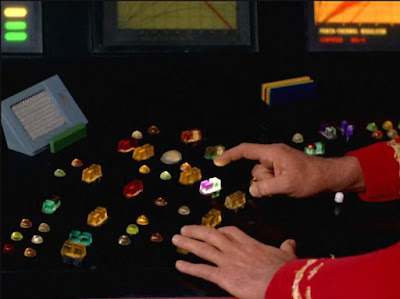
Don't do it, Scotty!

Putting aside the obvious question (i.e., how would anyone remember what each button does if they're not labeled?), let me just point you to an amazing web page that tracks down the origins of every gol-dang button on the bridge of the original starship Enterprise.  Some were repurposed from existing electronic equipment, and some were made from pouring colored resin into ice trays.  Don't believe me on the latter, do you?  See some recent fan attempts to make some!

This image speaks to me in a language I don't understand, but must follow. :-)

Another sci-fi TV show with interesting background graphical elements was 1978's Battlestar Galactica.  I loved all the quasi-Egyptoid and pseudo-Mormon symbolism, but in a post about buttons and keyboards, the closest thing I can think of is the joystick of the Colonial Viper ship...


The image on the left is the one seen most often... "fire" and "turbo" are obvious, and "IM" (inverse maneuver) was only used once: a rapid stop and reverse.  The image on the right was shown rarely -- possibly accidentally -- since it was the unaltered version. This prop really came from the cockpit of a Vietnam-era surveillance plane; it must have controlled the remote cameras on the outside of the aircraft.

Anyway, that's all for now.  If you're hungry for more stuff like this, there's a lot out there for the astute searcher.  There's also a surprising amount of interest in deconstructing the methods and meanings of sci-fi TV and movie "interfaces," too.  The blog that explored the Alien buttons and fonts also delved deeply into Kubrick's 2001 and a few other movies.  This blog had fascinating multi-post musings about the interfaces of Logan's Run, The Fifth Element, and quite a few others.

Lastly, I thought I'd show you the most sophisticated keyboard of all.  For the budding pirates in the audience, I give you the Corsair!


Tuesday, September 29, 2015

Cthulhu fhtagn!?

I've recently had a chance to fill in a huge, yawning gap in my geek cred.  Up until this past month, I'd never actually read any H. P. Lovecraft.

I've always known the tropes... In the 1980s, I practically memorized the "Cthulhu Mythos" section of the original D&D Deities & Demigods book.  I got the joke about "Uhluhtc" (oo-loo-tec) in the original Heavy Metal movie.  Heck, I own the game Call of Cthulhu, and I even consulted on a supplement for CoC back in the 1990s!

Artist: Erol Otus.  I'm trying to illustrate this post without any tentacles.

So shame on me for taking this long, for sure.  What spurred me to start reading wasn't Lovecraft himself, but rather a short story from 2014 by Ruthanna Emrys called "The Litany of Earth."  (Online in full here.)  It's powerful and very well-written.  I resist saying too much more about it because I'd like people to read it without preconceptions, as I did.  Suffice to say that it provides a new perspective on the Lovecraftian world that genuinely surprised and charmed me.

This story also got me to seek out more information about cosmicism, a (sorta kinda) real-world attempt to broaden Lovecraft's ideas into a coherent and satisfying belief system.  Despite its stereotypical veneer of bleakness and existential nihilism, there seems to be some raw material for a more positive and optimistic path; see here, for example.  I was already familiar with Kenneth Grant's mind-bending attempts to do something vaguely similar, but it was nice to see a few more modern, less occultish, perspectives on it all.

Virgil Finlay

However, the rub:

Nearly all of the ideas that fascinated me -- both from Emrys' story and from the cosmicistical writings I found on the web -- were extrapolations from Lovecraft... not really taken directly from what he says on the page.  His stories are powerful and interesting -- and I do intend on reading more of them to complete my education.  But after reading a handful, I'm learning that Lovecraft's well-known reputation for bleakness and terror is well justified.

I'm hoping to find some small kernels of hope in the remaining HPL stories in my queue.  I might give Derleth a try, too.  But I'm starting to suspect that Lovecraft may be a bit like another early 20th century thinker who ushered in some scary new ideas: Aleister Crowley.  Both kind of serve as anti-prophets -- i.e., conveyers of wild thoughts that spurred on others in unique ways, but who ought not to be "followed" too slavishly or literally.  That way lies, well, the mountains of madness.

Back to Erol Otus

Friday, September 25, 2015

Won't you please?

Won't you please?
Please won't you roll... for initiative?

Hat tip to the Old School Roleplaying FB page

In a way, it was the perfect gateway drug for RPGs and other imaginatory pursuits.  A trip to the Neighborhood of Make Believe every day?  Who could ask for more?  And given that land was filled with kings, trolls, witches, talking animals, and aliens from the Planet Purple (I'm lookin' at you, Arneson's Blackmoor) I see no incongruity here.

- - -

More content soon, folks.  This blog ain't dead yet!

Friday, August 21, 2015

Gen Con 2015

I usually don't talk much about games to colleagues in my professional life, but I do happen to be mentoring a grad student who is very much into board & card games.  I knew she was taking a trip to Indianapolis last month, but it took longer than it should have to figure out where she was really going.  Here's a snippet from the email I sent her a few weeks ago:
I just put two and two together.  You said "a game convention in Indianapolis."  Understatement of the year!  I didn't realize until now that I should have translated that as "the legendary game convention started by Gary Gygax in the 60s, which I read about all the time in Dragon magazine as a kid, and dreamed about attending all through the late 70s and most of the 80s."  :-)  :-)
That's probably more than I've talked about games to colleagues in the last 25 years!  But what did my student hand me when I saw her this week?


Am I going to have to actually start playing again so I can use these?  We'll see!  :-)

Wednesday, July 29, 2015

Church of the Big Gamble

Apologies for not a lot going on here lately.  I'll know the new direction I'm looking for when I see it.  :-)

The other day I came across a really thought-provoking blog post by Joey Vigour in defense of randomness in games.  It helped to explain some of my own (unformed) thoughts and predilections.


The basic idea is that there's a sweet spot between the two extremes of order and chaos.  Staying balanced on that knife-edge is difficult, but well worth it.  The more I thought about it, the more I'm sure this general idea applies to lots of things.  Let me just list a few of them...

Games:  Joey Vigour explained that including the "dark forces" of randomness (dice, cards, etc) in a game gives us a glimpse of the craziness of life.  I'll just let him tell you:
"So why do most game designers introduce an element of randomness to their games? I would argue that dark mystical (or at least unknown) forces are a game designer's ally because the introduction of chaos to a game causes our subconscious to be reminded of real life. Games are a simulacrum of life, but all the beautiful photo-realistic art and all the flavor text is still just fluff on top of the Spark that moves us emotionally. Understanding the Spark is the struggle of all artists: to know that there is unknowable, and to grasp at it in a comprehensive presentation."
Vigour also considers human strategizing as being in the same category with the dark forces of randomness -- after all, other people can sometimes be as inscrutable and hard to predict as a roll of the dice! -- so games like Chess can also invoke these feelings.  Still, too much of the human/random element in a game can be pointless and dreary (like never-ending games of Chutes and Ladders).  Too little of it gives you something easily solved, like Tic-Tac-Toe.

Stories:  The knife-edge between order and chaos is apparent in narratives, too.  Too much order gives us the logical tying and untying of plot-driven "knots."  I'm thinking of the inevitability of events in things like Greek and Shakespearean tragedies.  Fatalism can sometimes be interesting, but not in isolation.  Too much chaos is just surrealistic dada.  :-)

Life:  Too much order leads you right into a rut.  (Think of Mr. Incredible stuffed into his tiny car on a traffic-filled freeway... that had to be inspired by this song.)  Too much chaos means adrenalin and stress all the time, which is just plain not good for you, whether you're a superhero or not.

Music:  Goes without saying, I think.  Our ears and brains have evolved to respect the knife-edge between monotonous order and dissonant chaos.

There are probably so many other examples... enough to build a Glass Bead Game worthy of the ages, I'm sure.  By the way, the title of this post comes from old-school D&D; see here for more about my own history with it.

Back to Joey:
"So let’s embrace dice rolling, deck shuffling, hidden information, and mystery in games. It’s what our subconscious relates to anyway. It’s how we lose our forgetfulness and reconnect with hidden truths. It’s how we find ourselves. Anything less than that is just Tic-Tac-Toe."

Monday, June 15, 2015

Venus Paradise: Cyber Edition

I'm still not done thinking about the long-term goals of this blog, but there is one idea for a post that I've had for a few months, and I'd like to get it out there.  Does anyone remember these?


Some time in the early 1970s, I got a few of these color-pencil-by-numbers sets as Christmas gifts.  For young Cygnus, the color pencils were a godsend.  I loved the ubiquitous Crayola rainbow, but wax crayons left a lot to be desired.  They couldn't give you the fine lines of a pencil or pen... and if you stacked up a few of your creations on top of one another, the papers would stick together and get kind of goopy after a while.

I was fascinated by one particular brand... the Venus Paradise pencils, which had their own unique color palette.  Each color was assigned to an evocative name and a specific number in an esoteric sequence.  The numbers corresponded to the digits on the color-by-numbers outlines, but I don't remember filling in many of them.  I tended to just hoard the pencils and draw other stuff with them (and I still have some nubs left in a box somewhere).

 
So, a few months ago, I discovered a massive, labor-of-love web site for Crayloa crayon collectors.  Over the years I've also seen quite a few attempts at creating web-based color palettes out of the classic crayon colors.  But where's the digital love for Venus Paradise?  Someone might want to re-create their childhood color-pencil artwork as accurately as possible.  Okay, Cygnus (plus some image-grabbing software) to the rescue.

1. Deep Yellow:  (247, 210, 039),  #F7D227
2. Sarasota Orange:  (245, 120, 057),  #F57839
3. Poppy Red:  (231, 067, 069),  #E74345
4. Hollywood Cerise:  (255, 111, 145),  #FF6F91
5. Orchid Purple:  (089, 062, 103),  #593E67
6. Navy Blue:  (022, 057, 108),  #16396C
7. Peacock Blue:  (078, 195, 239),  #4EC3EF
8. Emerald Green:  (036, 179, 134),  #24B386
9. Deep Chrome Green:  (024, 092, 069),  #185C45
10. Photo Brown:  (136, 068, 032),  #884420
11. Chestnut Brown:  (067, 047, 026),  #432F1A
12. Midnight Black:  (017, 017, 016),  #111110
13. Ultramarine Blue:  (059, 123, 210),  #3B7BD2
14. Natural Flesh:  (246, 224, 181),  #F6E0B5
15. Lawn Green:  (056, 134, 079),  #38864F
16. French Green:  (203, 215, 087),  #CBD757
17. Smoke Gray:  (159, 153, 146),  #9F9992
18. Blush Pink:  (251, 133, 126),  #FB857E
19. Cherry Red:  (217, 057, 064),  #D93940
20. Arizona Topaz:  (243, 208, 119),  #F3D077
21. Indian Red:  (174, 064, 042),  #AE402A
22. Sky Magenta:  (208, 123, 154),  #D07B9A
23. Cotton White:  (254, 253, 253),  #FEFDFD
24. Lemon Yellow:  (253, 243, 132),  #FDF384
25. Bright Gold:  (195, 170, 117),  #C3AA75
26. Bright Silver:  (155, 185, 190),  #9BB9BE
27. Sky Blue:  (104, 192, 236),  #68C0EC

I so love those color names.  If I ever write a noir-ish crime drama, I'm sure I'll steal at least three or four character names from the above list.  I think #4 and #17 must be having an affair.

Here's what the digital RGB colors look like in graphical form:


Please do whatever you like with this information.  I'm still not sure why it's ending up on this blog.  I just know I had a blast putting it all together.  Right now, that's enough for me.

I should note that I never owned numbers 25 or 26.  According to the web, these two were the rarest colors of the bunch.  It took me a while to even find an image of #26 (see below... ain't it bee-u-tee-ful?).  For #25 I had to go slumming with online images of other brands to even begin to guess what "Bright Gold" might look like.  I'll find one someday!  :-)
